Pell Grants now fund eight-week programs, and the 1972 guardrail is back in play
Pell now funds eight-week programs, and the 1972 guardrail is back in play
Federal student aid was built around the academic term. This law opens Pell to training that can run as little as eight weeks — reopening a question Congress first answered in 1972, when it let for-profit schools into federal aid and attached a condition.
8 weeks
Shortest qualifying program length
§83002
The section that opened Pell to short-term training
July 1 2026
Effective date
1972
Year Pell and gainful employment were created
The short version
This breakdown went out as a carousel the same day. Same numbers, fewer words.
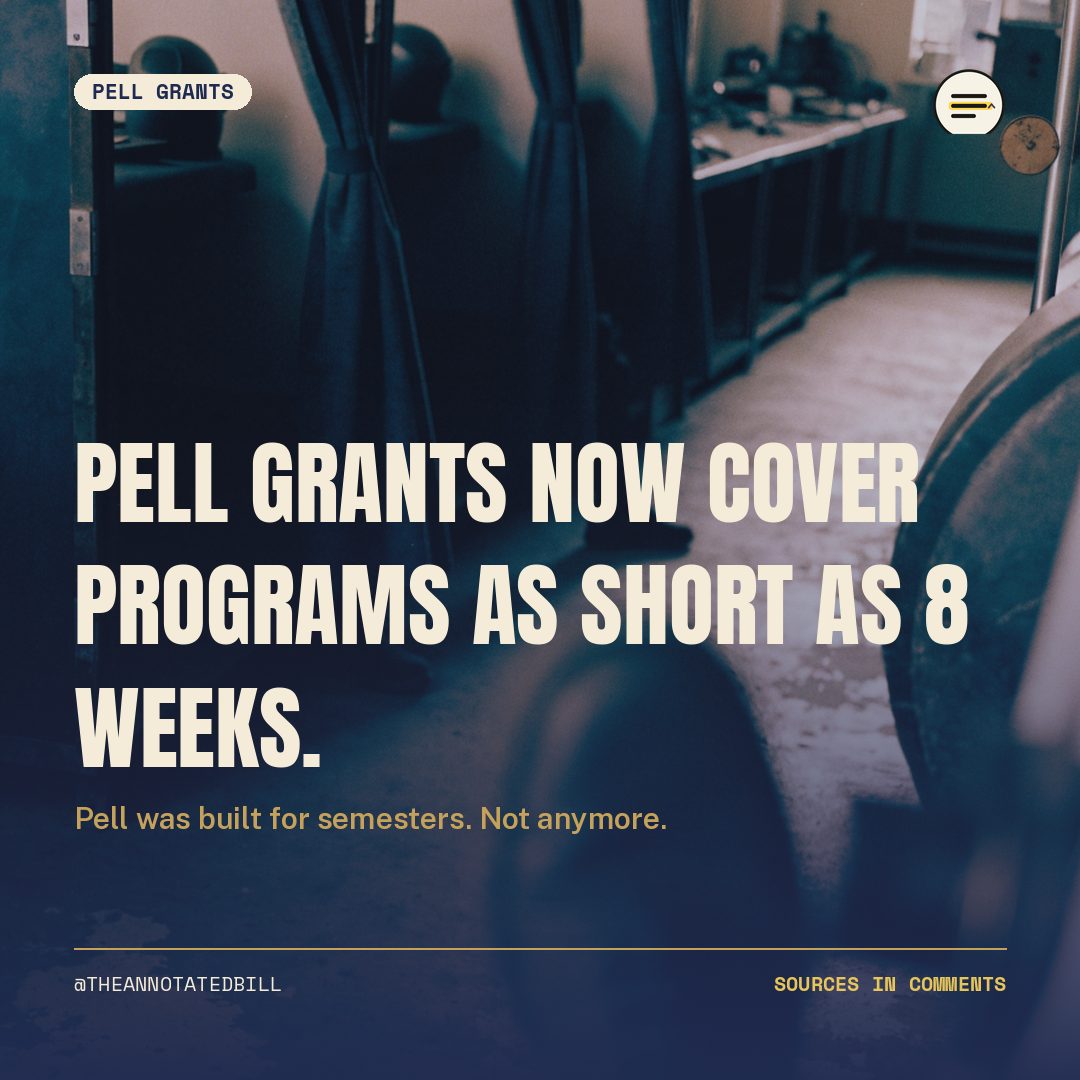
A length requirement, lowered
Section 83002 of P.L. 119-21 created Workforce Pell Grants, extending Pell eligibility to short-term training programs that were not previously eligible. Qualifying programs can run as little as eight weeks — far shorter than the minimum that applied before.
The provisions take effect July 1, 2026, aligning with the start of award year 2026–27 for federal student aid.
Federal aid moves from funding enrollment in a term to funding completion of a credential P.L. 119-21 §83002.
Margin notePell was built around semesters, credit hours and degree progress. A welding certificate or a commercial driving credential does not fit that structure, which is why such programs were historically outside federal grant aid regardless of their labour market value.
Pell and its guardrail were born in the same act
What became the Pell Grant started as the Basic Educational Opportunity Grant, created in the 1972 reauthorisation of the Higher Education Act and renamed in 1980 for Senator Claiborne Pell.
The same 1972 reauthorisation did something else. Before it, proprietary — for-profit — institutions were barred from participating in federal student aid under the Higher Education Act. The 1972 law let them in. As the trade-off, Congress limited their eligibility to programs that prepare students for gainful employment in a recognised occupation.

Eligibility was limited to programs that prepare students for gainful employment in a recognised occupation 1972 reauthorisation.
Margin noteThat phrase is the origin of every gainful employment rule since. It exists because Congress understood in 1972 that opening federal aid to short vocational programs required a standard tying the aid to whether the training actually led to work.
The case for, and the reason for the guardrail
The argument for Workforce Pell is strong and straightforward. A large share of well-paid work requires a credential rather than a bachelor’s degree, and federal grant aid was structurally blind to that path. A student pursuing a two-year degree could receive Pell; one pursuing a twelve-week credential leading to the same job could not.

The reason for caution is equally concrete. Short programs are inexpensive to launch, difficult to evaluate before outcomes exist, and historically the segment of higher education where low-value providers have concentrated. The entire modern accountability apparatus — gainful employment metrics, completion and placement reporting — grew out of problems in exactly this part of the sector.
Which means the outcome of this provision turns almost entirely on the eligibility standards and how they are enforced, not on the statute’s length threshold.
Both cases, in their own words
This site does not referee motives. Here is each side’s strongest version, at the same length and in the same register.
The aid system was biased toward degrees
Federal grant aid followed the academic calendar rather than the labour market. Supporters argue that bias pushed students toward longer and more expensive credentials than their goal required.
Short is not the same as low quality
A commercial driving credential or a welding certificate can produce an immediate, verifiable wage gain at a fraction of the cost and time of a degree.
The alternative is debt
Students pursuing short programs without grant eligibility have been financing them privately. Extending Pell substitutes a grant for a loan.
This is where the failures have been
Critics point to a long record of short-program providers with weak completion and placement outcomes, and argue federal grant money arriving before accountability rules are settled repeats a known mistake.
Eight weeks is very short
A two-month program leaves little room to distinguish real training from a credential with no labour-market value, and outcomes data takes years to accumulate.
Quality rules are in flux
The gainful employment framework has been written, struck down, rewritten and litigated repeatedly. Expanding eligibility while the guardrail is unsettled puts the aid ahead of the oversight.
The honest framing was never about eight weeks
Congress faced this question in 1972 and answered it with a condition rather than a prohibition: short vocational programs could receive federal aid, provided they prepared students for gainful employment. Workforce Pell asks the same question again, at larger scale.
Congress
Set the eight-week floor and the July 2026 start, and left the quality standards to the rulemaking process.
The Department of Education
Writes the eligibility criteria, which is where this provision will succeed or fail.
Students
Get access to grant aid for a path the system has excluded for fifty years — with the protection depending on rules not yet settled.
What is settled, for now: Pell can fund programs as short as eight weeks from July 1, 2026, under section 83002, with award year 2026–27 the first in which it applies.
Sources
Every claim above traces to one of these.
- P.L. 119-21 §83002 — Workforce Pell Grants
- CRS IF13253, Workforce Pell Grants — eight-week minimum program length and July 1, 2026 effective date
- Alignment with the start of award year 2026–27 for federal student aid
- Higher Education Act reauthorisation of 1972 — creation of the Basic Educational Opportunity Grant, renamed for Senator Claiborne Pell in 1980
- 1972 extension of federal student aid eligibility to proprietary institutions
- The 1972 statutory condition limiting eligibility to programs preparing students for gainful employment in a recognised occupation
Send it to someone weighing a trade program
Every figure above is sourced. Pass it on with the sources attached.
The ABLE contribution increase is now permanent
And about 1% of the people who could use these accounts have one.