$50 billion for rural health — if your state asks for it
$50 billion for rural health — if your state asks for it
The Rural Health Transformation Program appropriates $50 billion over seven years. Allotments go only to states that apply and spend against an approved plan — which means the decision that determines whether the money arrives gets made in a statehouse.
$50B
Appropriated, FY2026–FY2032
7 yrs
The window to obligate it
Apply
No application, no allotment
100+
Rural hospitals closed since 2010
The short version
This breakdown went out as a carousel the same day. Same numbers, fewer words.
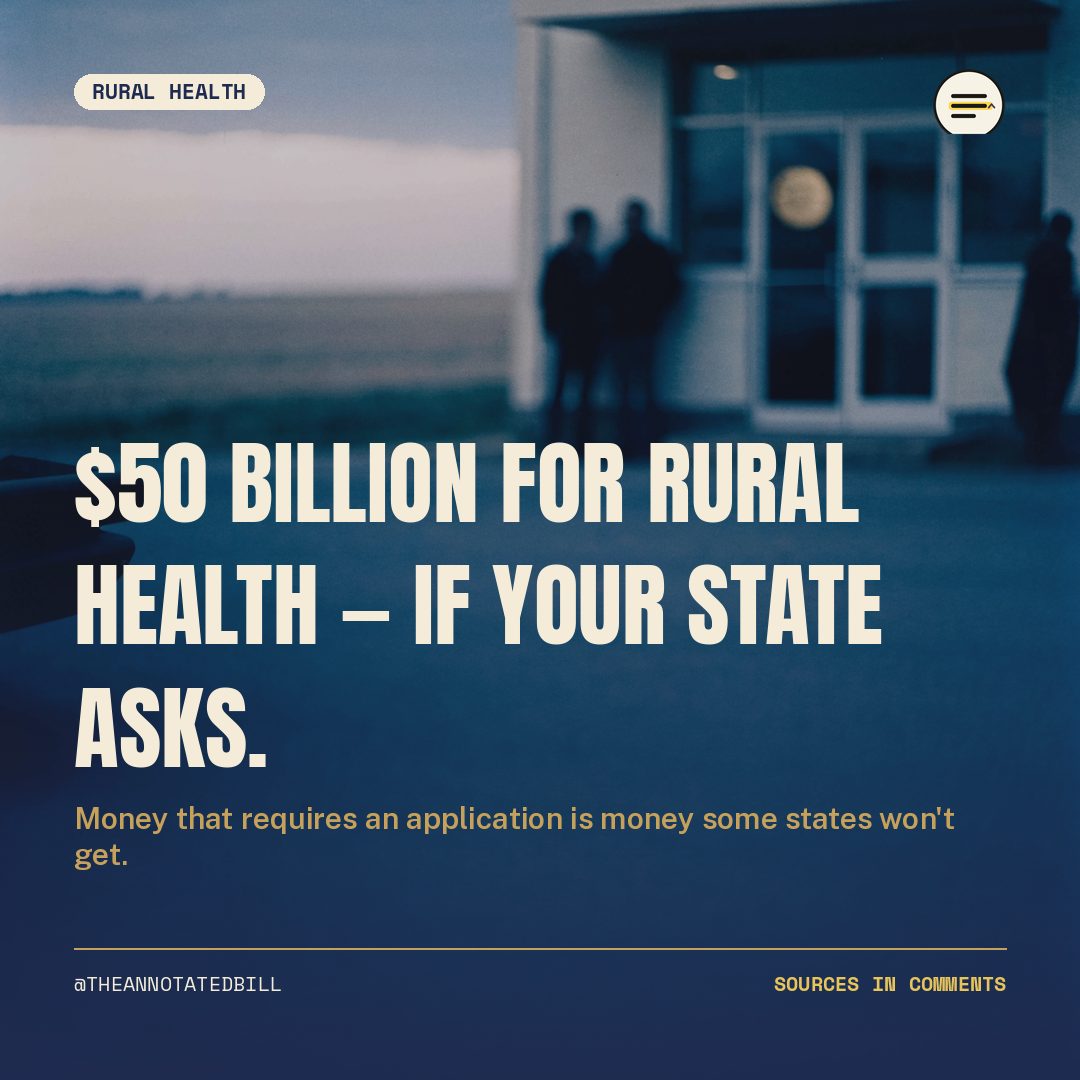
An appropriation with a condition attached
P.L. 119-21 creates the Rural Health Transformation Program and appropriates $50 billion across fiscal years 2026 through 2032.
The money is distributed as state allotments. A state receives an allotment only if it submits an application, and may spend only in accordance with that state’s rural health transformation plan as approved.
Federal money that requires a state to opt in is federal money some states will not take CRS R48633.
Margin noteThis is not a prediction about any particular state. It is a description of how opt-in federal programs have behaved historically, including the Medicaid expansion, where a decade after the option became available a number of states had still not taken it.
Eighty years of federal rural hospital policy
Federal involvement in rural hospital capacity is not new. The Hospital Survey and Construction Act of 1946 — the Hill-Burton Act — funded the construction of hospitals across rural America, and much of the rural hospital infrastructure that exists today dates from that era.

Hill-Burton built buildings. The problem now is operating revenue, which is a different problem with a different solution set. A rural hospital does not close because it lacks a building; it closes because its payer mix cannot cover its fixed costs.
More than 100 closures since 2010
Researchers tracking rural hospital closures count more than 100 since 2010. The closures are not evenly distributed: they cluster in states that did not expand Medicaid, and more than half have been in the South.

Analyses of financial distress have put roughly 430 rural hospitals in the category of near collapse — operating at losses that are not sustainable without a change in revenue or cost.
Against that, $50 billion over seven years is substantial money. The question the statute leaves open is whether it reaches the hospitals in the most distress, because the geographic pattern of the closures and the geographic pattern of states most likely to decline an opt-in program have historically overlapped.
Both cases, in their own words
This site does not referee motives. Here is each side’s strongest version, at the same length and in the same register.
States know their own rural systems
A state plan can consolidate services, fund transport, or convert facilities to a different model. Supporters argue a formula written in Washington could not make those judgements.
The plan requirement is accountability
Requiring a transformation plan means the money is tied to a strategy rather than distributed as general operating support that delays closures without changing the underlying economics.
It is new money at real scale
$50 billion is larger than most previous federal rural health commitments, and the seven-year window allows multi-year projects.
Opt-in programs leave gaps
The Medicaid expansion showed that some states decline federal money for years. Critics argue the states with the most distressed rural hospitals are among the most likely not to apply.
Application capacity is itself unequal
Writing a competitive state plan requires administrative capacity. Critics argue this advantages states that already have well-resourced health agencies.
It sits alongside large health reductions
The same law reduces federal health spending substantially over ten years. Critics argue $50 billion over seven years does not offset that for rural providers whose revenue depends on Medicaid.
The honest framing was never about the $50 billion
The number in the headline is real and it is large. The structural fact underneath it is that Congress appropriated the money and then placed the decision about whether it arrives with fifty separate governments, each of which will make that decision on its own timeline and for its own reasons.
Congress
Appropriated $50 billion for FY2026–FY2032 and conditioned it on state application and an approved plan.
States
Decide whether to apply, what to propose, and how fast. That decision happens in a statehouse.
Rural hospitals
Have seen more than 100 closures since 2010, clustered in non-expansion states and the South.
What is settled, for now: $50 billion appropriated across FY2026–FY2032, allotted only to states that apply and spend against an approved rural health transformation plan.
Sources
Every claim above traces to one of these.
- P.L. 119-21 — establishment of the Rural Health Transformation Program and appropriation of $50 billion for FY2026 through FY2032
- CRS R48633, Health Provisions in P.L. 119-21
- Requirement that states submit an application to receive an allotment
- Requirement that spending follow the state’s approved rural health transformation plan
- Hospital Survey and Construction Act of 1946 (Hill-Burton Act) — federal funding for rural hospital construction
- UNC Sheps Center for Health Services Research — rural hospital closure tracking, 100+ closures since 2010, clustered in non-expansion states with more than half in the South
- Analyses identifying roughly 430 rural hospitals in severe financial distress
Send it to someone in a rural hospital town
Every figure above is sourced. Pass it on with the sources attached.
Only 9 of 50 states keep their SNAP error rate under 6%
That threshold now decides who pays for the program.