Arkansas tried this in 2018. 18,000 people lost coverage and a court struck it down.
Arkansas tried this in 2018. A court struck it down.
Medicaid work requirements are not a new idea. One state ran the experiment eight years ago, at 80 hours a month — the same figure in this law. More than 18,000 people lost coverage before a federal court vacated the approval.
Jan 1 2027
When the requirement begins
18,000+
Arkansans who lost coverage in 2018
80 hrs
Monthly requirement, then and now
2019
Year a court vacated the Arkansas approval
The short version
This breakdown went out as a carousel the same day. Same numbers, fewer words.
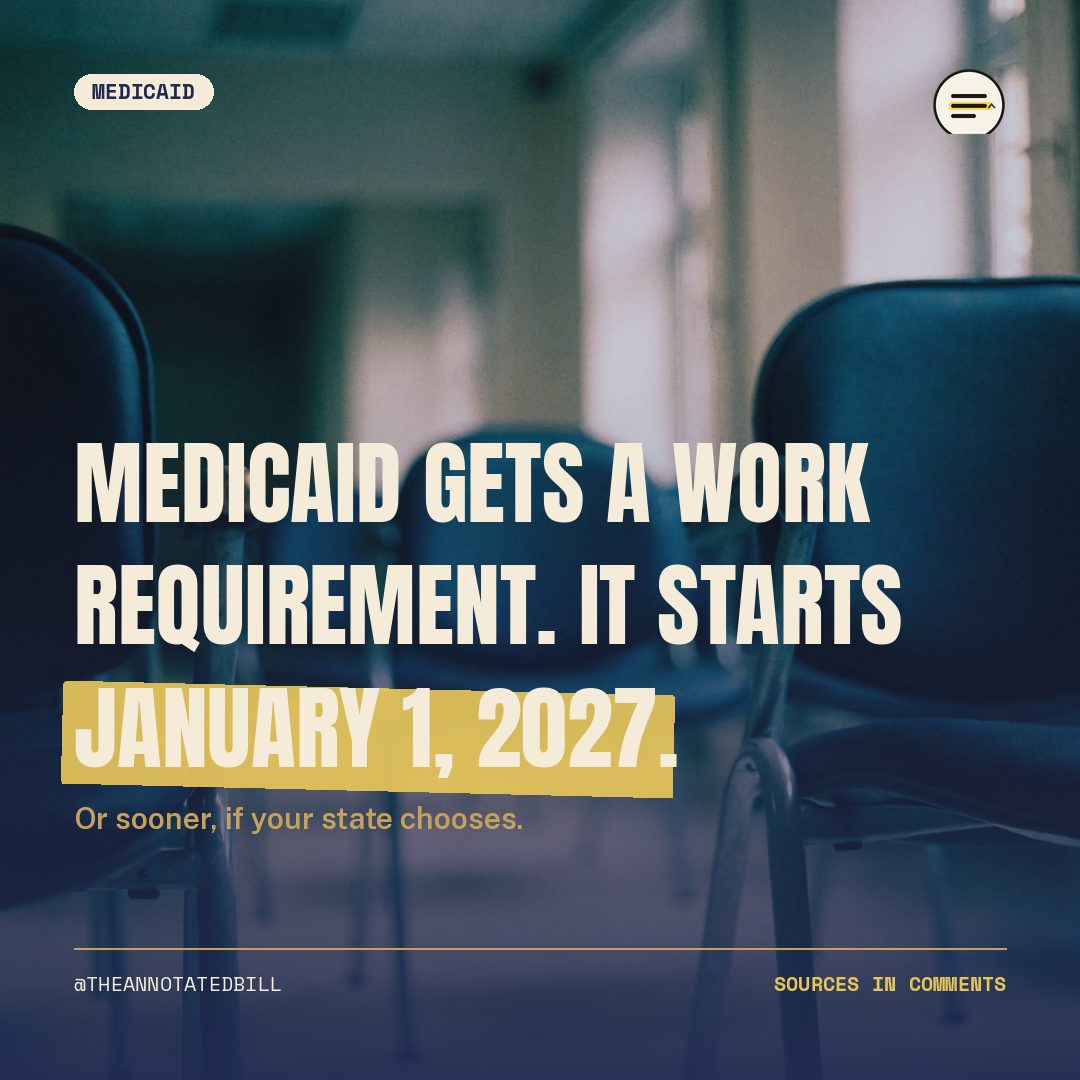
What the statute actually requires
P.L. 119-21 establishes what the statute calls a community engagement requirement for certain Medicaid enrollees, applying from January 1, 2027 — or earlier, at state option.
The requirement can be met by work, a work program, community service, or enrollment in an education program CRS R48633.
Margin noteA full-time student satisfies it. So does a volunteer. The phrase ‘work requirement’ compresses something genuinely broader, and that breadth is the strongest part of the policy’s design.
Because states may begin earlier than January 2027, the rollout will not be uniform. Two people in identical circumstances in neighbouring states may encounter the requirement a year apart.
Arkansas Works, 2018
In March 2018 the Secretary of Health and Human Services approved the Arkansas Works Amendments, which conditioned Medicaid coverage on documenting 80 hours a month of qualifying activity — the same monthly figure used today. Kentucky had a comparable proposal.
Arkansas began disenrolling people in September 2018. The first cohort removed was 4,353 people. By the time the program was halted, more than 18,000 Arkansans had lost coverage.

Ten Arkansans sued in federal court in August 2018. On March 27, 2019 the district court vacated the Secretary’s approval, and the D.C. Circuit subsequently held that the approval was arbitrary and capricious under the Administrative Procedure Act — because the Secretary had not adequately considered whether the program furthered Medicaid’s central objective of providing medical assistance.
A statute is not a waiver
The legal vulnerability that killed Arkansas Works does not apply here, and this is the single most important thing to understand about the comparison.
Arkansas operated under a demonstration waiver — an administrative approval that courts reviewed for consistency with the Medicaid statute’s own purposes. The courts found it wanting. A requirement written directly into federal statute by Congress is not vulnerable to that line of attack, because Congress is amending the statute rather than an agency departing from it.

So the Arkansas record is not a prediction about litigation. It is evidence about implementation — specifically, about what happens to coverage when an 80-hour monthly reporting obligation meets a real caseload.
Most people who lost coverage were working or exempt
The central finding from Arkansas was not that large numbers of people refused to work. It was that large numbers of people who were working, or who qualified for an exemption, lost coverage anyway — because they did not know about the requirement, could not use the online reporting portal, or did not complete the monthly reporting correctly.
That is the implementation risk this provision carries into 2027, and it is why the design details that have not yet been written — how hours are verified, whether payroll data can be matched automatically, what notice is given, how exemptions are applied — will matter more than the requirement itself.
Both cases, in their own words
This site does not referee motives. Here is each side’s strongest version, at the same length and in the same register.
The expansion population is working-age adults
Supporters argue a participation expectation for able-bodied adults without dependents is consistent with how other means-tested programs operate, and that Medicaid expansion changed who the program covers.
The qualifying activities are broad
Education, training, community service and work all count. The policy is not a requirement to hold a job.
Congress chose it directly
Unlike 2018, this is a statutory decision by the elected branch rather than an agency approval, which supporters argue is the legitimate way to make a change of this scale.
We have run this test
Arkansas produced 18,000 coverage losses and no measurable employment gain. Critics argue the burden of proof now sits with anyone claiming a different result.
Reporting is the real requirement
The binding constraint is monthly documentation, which fails hardest for people with irregular hours, unstable housing or limited internet access — not for people refusing work.
Losing coverage makes work harder
Critics note that untreated chronic conditions reduce the ability to hold a job, so coverage loss can undercut the stated objective.
The honest framing was never about work
The question is not whether people should work. It is whether a monthly documentation system can distinguish between someone who is not working and someone who cannot prove that they are — and what the consequence of failing that test should be.
Congress
Put the requirement in statute, which removes the legal vulnerability that ended the 2018 attempt.
The states
May start before January 2027 and will design the verification, which is where the Arkansas failures occurred.
The evidence
Already exists, from one state, at the same 80-hour threshold. It is the most relevant data anyone has.
What is settled, for now: a community engagement requirement from January 1, 2027 or sooner at state option, satisfied by work, a work program, community service or education — and one prior American attempt at the same monthly threshold that ended with more than 18,000 people losing coverage.
Sources
Every claim above traces to one of these.
- P.L. 119-21 — Medicaid community engagement requirement effective January 1, 2027, or earlier at state option
- CRS R48633, Health Provisions in P.L. 119-21
- Qualifying activities: work, participation in a work program, community service, or enrollment in an education program
- HHS approval of the Arkansas Works Amendments, March 5, 2018, including an 80-hour monthly requirement
- Arkansas disenrollments beginning September 2018; first cohort of 4,353; more than 18,000 total coverage losses
- Gresham v. Azar — complaint filed August 14, 2018; district court judgment vacating the approval, March 27, 2019
- D.C. Circuit holding that the Secretary’s approval was arbitrary and capricious under the Administrative Procedure Act
Send it to someone on Medicaid
Every figure above is sourced. Pass it on with the sources attached.
Graduate borrowing now has a hard lifetime ceiling
Tuition doesn’t have a cap. Federal lending now does.