The EV credit didn’t get cut in this law. It expired in September 2025.
The EV credit didn’t get cut in this law. It expired in September 2025.
Most coverage of this law is still written in the future tense. On electric vehicles that framing is simply wrong: the consumer credits for new and used clean vehicles are already gone, and the home charging credit is on its way out.
Sept 2025
When the consumer credits expired
30D
New clean vehicle credit, gone
25E
Used clean vehicle credit, gone
Mid-2026
Home charging credit phase-out
The short version
This breakdown went out as a carousel the same day. Same numbers, fewer words.
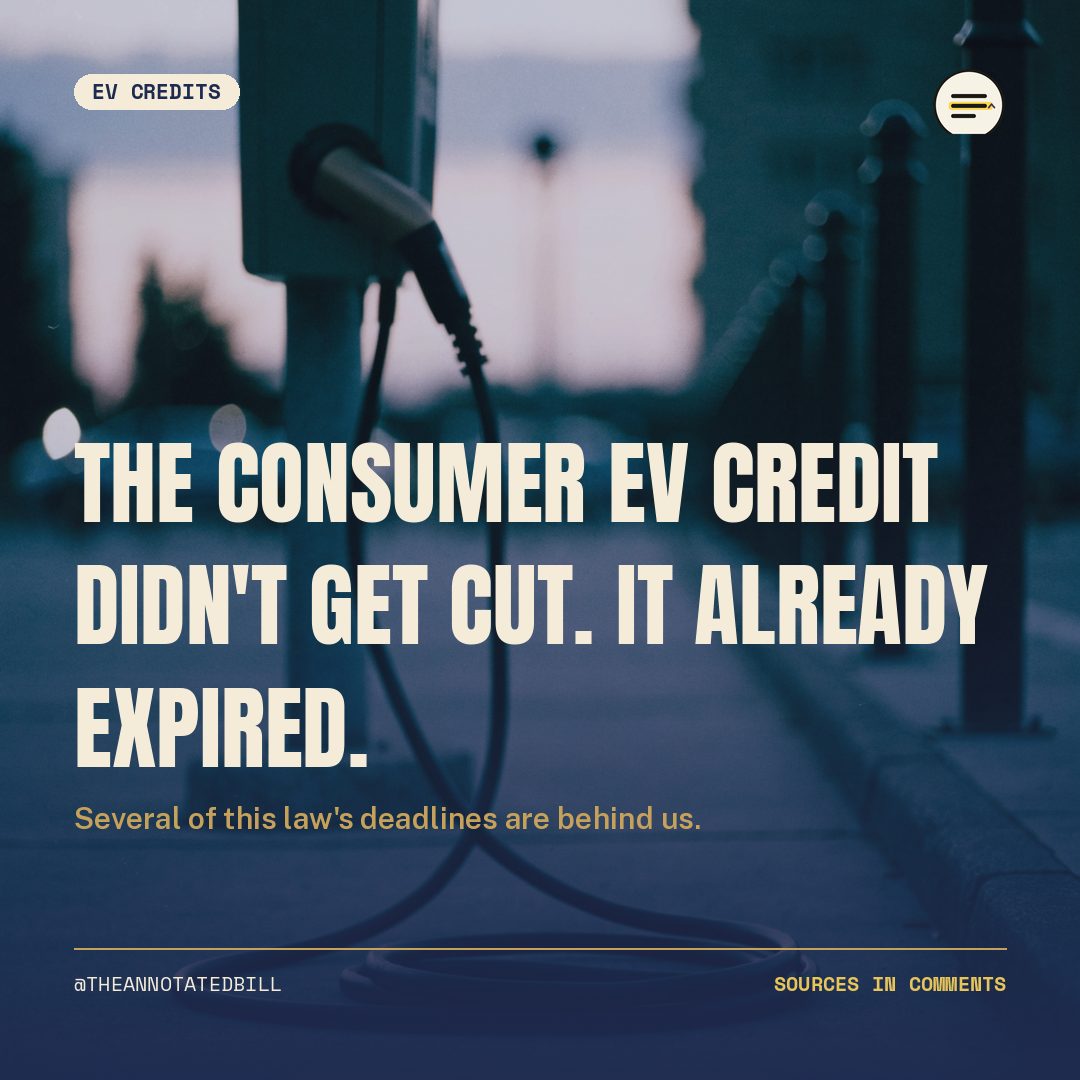
Three credits, three different dates
The consumer clean vehicle credits expired in September 2025. That covers both the credit for new clean vehicles and the credit for used ones.
The home EV charging equipment credit is on a slower path and phases out by the middle of 2026.
For these provisions the deadline is in the past, not the future CRS IN12611; EESI.
Margin noteA buyer comparing an electric vehicle today is comparing it without a federal credit, not in anticipation of losing one. Articles written during the legislative debate that describe the credits as something that ‘will’ end are now describing a world that ended in September 2025.
This was a discount, not a refund
The new clean vehicle credit was worth up to several thousand dollars and, under rules that took effect in 2024, could be transferred to the dealer and applied at the point of sale.

That design change mattered more than it sounds. A credit claimed the following April is a tax benefit; a credit applied at the dealership is a discount on the sticker. Buyers experienced it as a price cut, and removing it is experienced the same way — immediately, and at the point of comparison with a petrol vehicle.
The energy deadlines are clustered and already running
Read together, the energy provisions of this law form a short calendar rather than a policy statement. The consumer EV credits ended in September 2025. The home energy efficiency credit ended with calendar 2025. The residential clean energy credit was repealed for post-2025 expenditures. The EV charging credit runs out by mid-2026.

For a household making decisions about a vehicle, a roof or a heating system, the practical advice that follows is narrow and unglamorous: check the date on whatever you are reading. On these provisions, a year-old article is describing different law.
Both cases, in their own words
This site does not referee motives. Here is each side’s strongest version, at the same length and in the same register.
The market has moved
Electric vehicles are no longer a novelty segment requiring subsidy to exist. Supporters argue the credits were transitional and the transition has largely happened.
The benefit skewed upward
Even with income caps, new-vehicle purchase credits flow to households able to buy new cars. Critics of the credits from the left and right both made this point.
It is a large and ongoing revenue cost
Point-of-sale transferability increased uptake substantially, which also increased the fiscal cost.
It removes support mid-transition
Automakers made multi-year capital commitments partly on the expectation of demand support. Critics argue abrupt removal destabilises investment already in progress.
The used-vehicle credit was the progressive one
The 25E credit for used clean vehicles was the provision most likely to reach moderate-income buyers, and it ended at the same time.
Charging infrastructure is the bottleneck
Phasing out the home charging credit weakens the part of the system that makes ownership practical for people without garages or workplace charging.
The honest framing was never about the credit
The most useful thing to know about the energy provisions in this law is not whether they were right. It is that several of them have already taken effect, which is unusual for legislation still being discussed in the future tense.
Buyers
Face unsubsidised pricing now, not later.
The charging credit
Is the one still running, and it ends by the middle of 2026.
The coverage
Largely has not caught up, which is why the dates are worth checking directly.
What is settled, for now: no consumer credit for new or used clean vehicles since September 2025, and a home charging credit phasing out by mid-2026.
Sources
Every claim above traces to one of these.
- CRS IN12611 — expiration of clean energy tax credits following P.L. 119-21
- EESI, Where Key Clean Energy Tax Credits Stand
- Expiration of the IRC §30D new clean vehicle credit and §25E used clean vehicle credit in September 2025
- Phase-out of the IRC §30C home EV charging credit by mid-2026
- Point-of-sale transferability of the new clean vehicle credit to dealers
Send it to someone shopping for an EV
Every figure above is sourced. Pass it on with the sources attached.
One section cut the CFPB’s funding cap almost in half
The Supreme Court upheld that funding in 2024. Congress cut it in 2025.