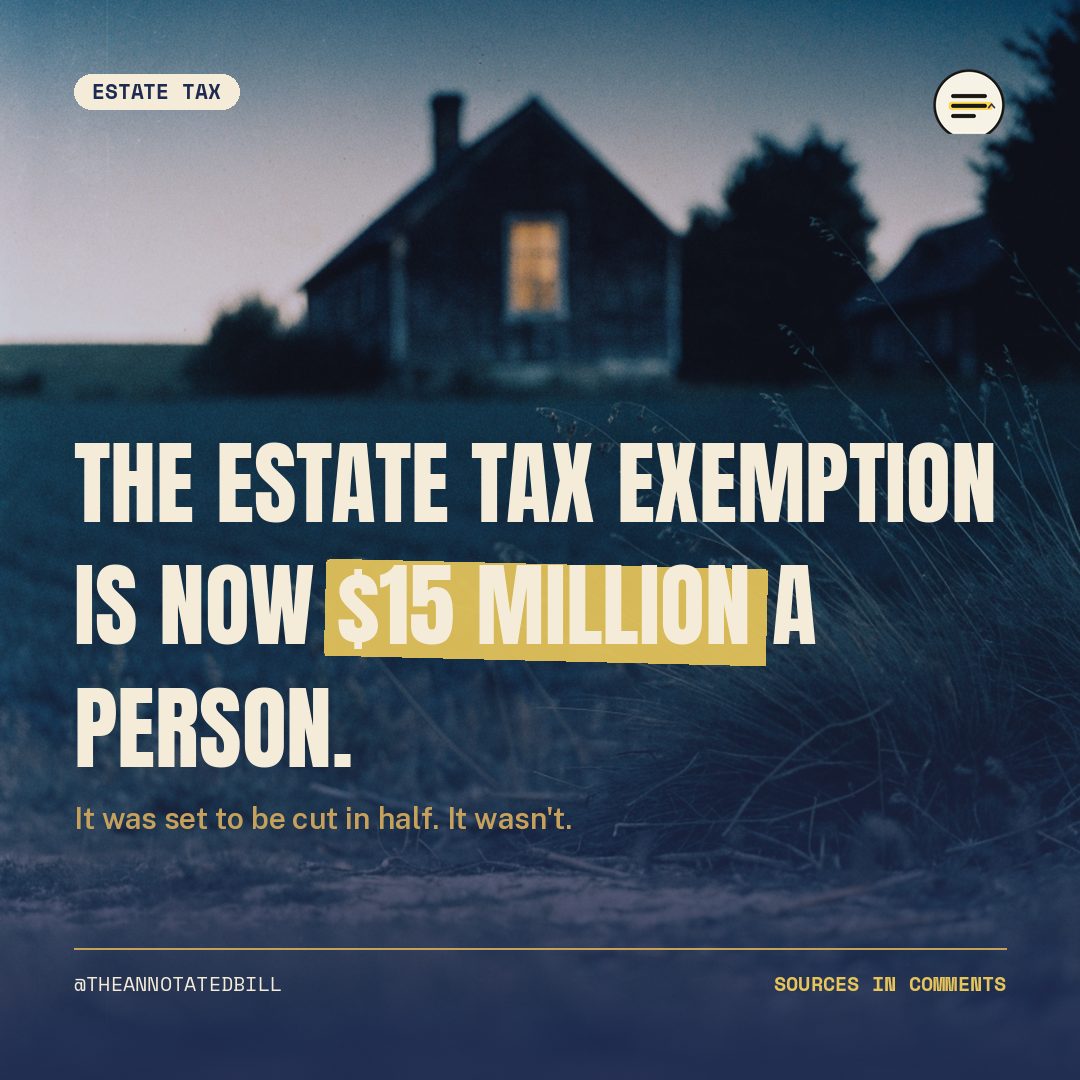
The estate tax exemption is now $15 million a person
The estate tax exemption is now $15 million a person
The doubled exemption was set to fall by half at the end of 2025. Instead it was kept and indexed, which means it rises every year from here. The tax did not change. The number of families it is a question for did.
$15M
Exemption per person, 2026
~$30M
Shielded by a married couple
0.1%
Of deaths producing any estate tax
$675K
The exemption in 2001
The short version
This breakdown went out as a carousel the same day. Same numbers, fewer words.
What was scheduled to happen, and didn’t
The 2017 tax law roughly doubled the estate and gift tax exemption, and — as with most of its individual provisions — set the increase to expire at the end of 2025. On January 1, 2026 the exemption would have reverted to roughly half its level.
P.L. 119-21 kept the higher exemption and indexed it for inflation. For 2026 it stands at $15 million per person, and it rises from there rather than falling.
The exemption is per decedent, and portability lets a surviving spouse use the unused share CRS R48183.
Margin noteThis is why the practical number for a married couple is about $30 million. It also means the planning question for most families is not whether they owe estate tax but whether they need to file anything at all.
A quarter century of moving the line
The exemption has not been stable in living memory. It was $675,000 in 2001, rose through $1 million, $1.5 million, $2 million and $3.5 million across the 2000s, disappeared entirely for one year, returned at $5 million, stood at $5.49 million in 2017, and is $15 million in 2026.

The missing year is not a typo. Under the 2001 tax law’s scheduling, the estate tax was repealed outright for 2010 — and was due to return at its old, far lower exemption in 2011. For twelve months, the United States had no federal estate tax at all, and estates of people who died in that window were treated differently from those who died on either side of it.
That episode is the strongest available argument for what this provision did. Whatever one thinks about the right level, scheduling a tax to vanish and reappear produces outcomes nobody designed and nobody can defend.
Roughly one death in a thousand
As the exemption has risen, the share of estates that owe anything has collapsed. In 2001, with a $675,000 exemption, around 2% of decedents produced an estate tax. By 2017, with a $5.49 million exemption, roughly 0.2% did — about two in a thousand. Today the figure is closer to 0.1%, on the order of 2,500 to 3,000 estates a year nationwide.

A $15 million per-person exemption, indexed, pushes that number lower still. The estate tax remains on the books with its rate structure and its deductions intact — including an unlimited deduction for charitable bequests — but as a practical matter it is a tax on a very small and shrinking set of estates.
Both cases, in their own words
This site does not referee motives. Here is each side’s strongest version, at the same length and in the same register.
Illiquid estates are the real problem
A farm, a ranch or a closely held business can be worth far more on paper than the family can raise in cash. Supporters argue a high exemption prevents the outcome where heirs sell the operating asset to pay the tax on it.
Predictability has value of its own
The 2010 repeal year is the case in point. Estate planning runs on decades. A stable, indexed exemption is better policy than a number that lurches with each Congress.
It is a small revenue source
Reaching roughly 0.1% of deaths, the estate tax raises a modest share of federal revenue relative to the planning industry it sustains.
It is the one tax on inherited advantage
Critics argue the estate tax is the only federal tax that touches wealth passed between generations, and that raising the exemption to $15 million and indexing it functionally retires it for all but a few thousand families a year.
The illiquidity case is already handled
Existing law allows extended installment payment for closely held business interests. Critics argue the farm-and-business argument justifies targeted relief, not a $15 million threshold.
Indexing is the permanent part
Most individual provisions in this law expire. This one escalates automatically — which over a couple of decades does more than the headline number suggests.
The honest framing was never about the rate
Almost every argument about the estate tax is conducted in terms of its rate. The rate has barely moved. The exemption has moved by a factor of more than twenty since 2001, and that is the number that decides who the tax applies to.
Congress
Has repeatedly set the exemption on a schedule and then changed the schedule, including letting the tax lapse for a single year.
The indexing
Does the work quietly from here. No future vote is needed for the threshold to keep climbing.
The filing question
Remains separate from the paying question. Estates well under the threshold may still need to file to preserve portability for a surviving spouse.
What is settled, for now: $15 million per person for 2026, indexed upward from there, roughly $30 million for a married couple, and about one death in a thousand producing any federal estate tax at all.
Sources
Every claim above traces to one of these.
- P.L. 119-21 — estate and gift tax exemption set at $15 million for 2026, indexed thereafter
- CRS R48183, The Estate and Gift Tax: An Overview
- Exemption history: $675,000 (2001) through $5.49 million (2017)
- Economic Growth and Tax Relief Reconciliation Act of 2001 — scheduling that repealed the estate tax for 2010
- Share of decedents producing an estate tax: approximately 2% (2001), 0.2% (2017), about 0.1% currently
- Estimated 2,500–3,000 taxable estates a year
- Unlimited estate tax deduction for charitable bequests
Send it to someone who thinks the estate tax is coming for them
Every figure above is sourced. Pass it on with the sources attached.
You can deduct car loan interest now — on some cars
Where the vehicle was assembled decides whether your loan qualifies.