The cheapest health plans just became the ones you can save against
The cheapest health plans just became the ones you can save against
Health savings accounts were built for high-deductible plans. Bronze and catastrophic marketplace plans have high deductibles — but for years most did not technically qualify, which locked their holders out of the main tool for paying those deductibles.
Jan 1 2026
Date the change took effect
~$7,500
Average 2026 bronze plan deductible
41.7M
HSA accounts at the end of 2025
2003
Year HSAs were created
The short version
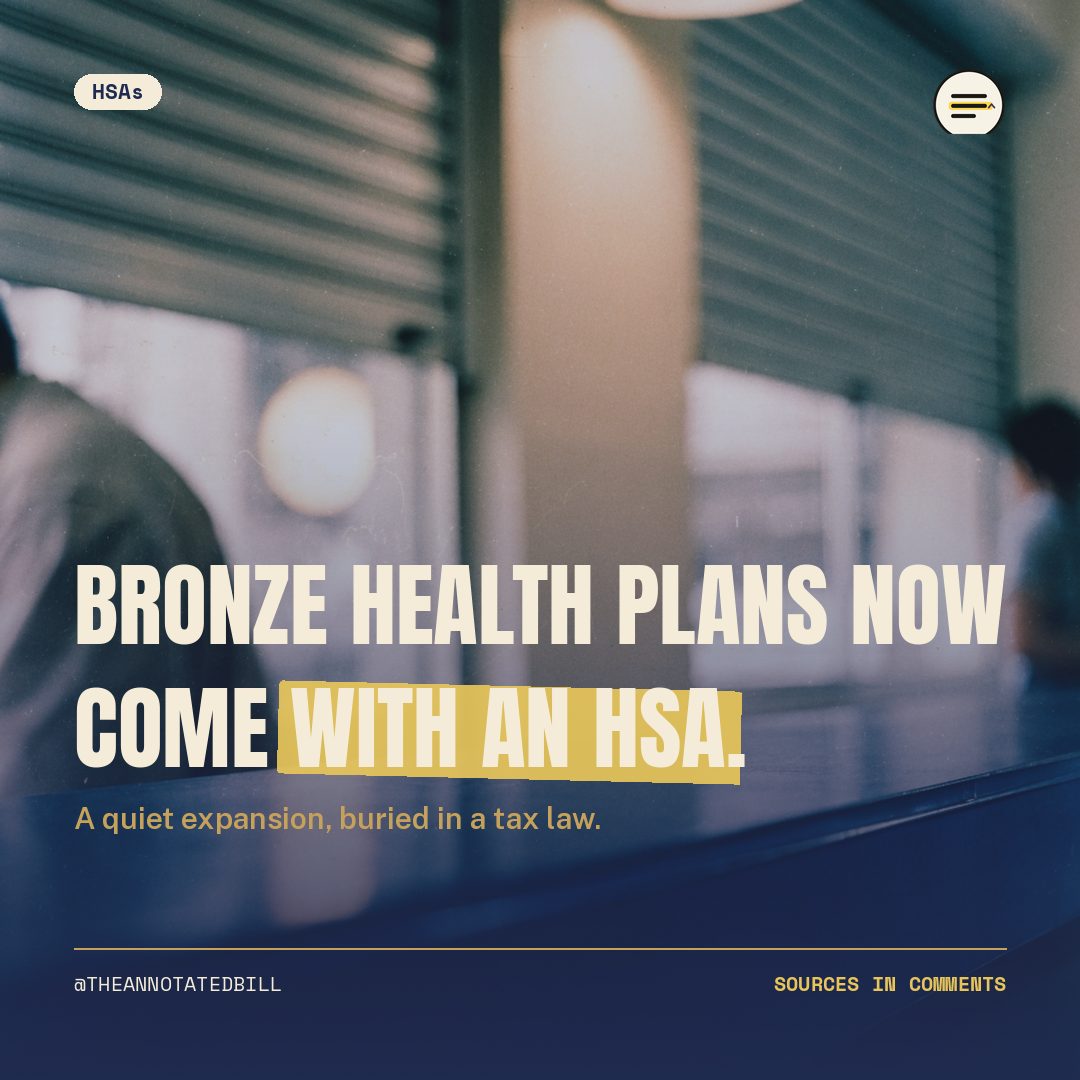
This breakdown went out as a carousel the same day. Same numbers, fewer words.
A definitional fix with real consequences
As of January 1, 2026, bronze and catastrophic plans available through an exchange are treated as HSA-compatible under §223 — regardless of whether they satisfy the general statutory definition of a high-deductible health plan.
Bronze and catastrophic plans qualify whether or not they meet the HDHP definition, and need not be bought on an exchange Notice 2026-05.
Margin noteThe HDHP definition turns on more than the deductible: it sets minimum deductibles, maximum out-of-pocket limits, and strict rules about what can be covered before the deductible is met. Many bronze plans failed one of those technical tests while being, in every ordinary sense, high-deductible plans.
The people with the most exposure had the fewest tools
The average deductible on a 2026 bronze marketplace plan is roughly $7,500. Bronze plans are also ineligible for cost-sharing reductions, the subsidy that lowers out-of-pocket costs on silver plans.
So the group holding bronze coverage faces the largest gap between what they pay in premiums and what they owe before coverage does much — and until this change, most of them could not open the account designed precisely to pay that gap with pre-tax dollars.

That was not a deliberate policy choice. It was the interaction of two statutes written sixteen years apart, and the result was a mismatch nobody designed.
HSAs are a 2003 idea, now holding $174 billion
Health savings accounts were created by the Medicare Prescription Drug, Improvement, and Modernization Act, signed in December 2003 and effective from January 2004. The design was explicit: pair a high-deductible plan with a tax-advantaged account, so the holder has a vehicle to cover the deductible.
By the end of 2025, HSAs held nearly $174 billion across 41.7 million accounts. The accounts carry an unusual triple tax advantage — contributions reduce taxable income, growth is untaxed, and withdrawals for qualified medical expenses are untaxed.

The Affordable Care Act, passed seven years after HSAs were created, built its metal tiers — bronze, silver, gold, platinum — on actuarial value rather than on the HDHP definition. The two frameworks were never reconciled. This provision reconciles them.
Both cases, in their own words
This site does not referee motives. Here is each side’s strongest version, at the same length and in the same register.
It fixes an accident
Nobody intended to exclude the highest-deductible plans on the exchange from the high-deductible savings vehicle. Supporters argue this is technical repair, not an expansion of policy.
It reaches people with real exposure
A $7,500 deductible is exactly the situation HSAs were built for. Extending eligibility to bronze enrollees targets the benefit at the people facing the largest out-of-pocket risk.
The tax treatment is uniquely favourable
No other account offers untaxed contributions, growth and qualified withdrawals. Opening it to more people is a substantial benefit per household.
You need spare money to use it
An HSA only helps someone with income left over to save. Critics argue the bronze population is disproportionately unable to fund an account, which makes the benefit largest for those who need it least.
It is a subsidy that scales with tax bracket
A deduction is worth more to higher earners. The same $1,000 contribution delivers a larger benefit further up the income scale.
It makes high-deductible coverage more attractive
Critics argue sweetening bronze plans nudges people toward thinner coverage, where cost is the main barrier to care.
The honest framing was never about bronze plans
This provision is a reminder that much of health policy is not made in health legislation. A definition in the tax code decided, for sixteen years, which Americans could save for their own deductibles.
The tax code
Sets the HSA eligibility rules, and therefore decides who can use the main tool for paying out-of-pocket costs.
The ACA
Set the metal tiers on a different basis entirely, which is how the mismatch arose.
IRS guidance
Did the reconciling, in a notice issued after the statute, which is where most of the operative detail now lives.
What is settled, for now: bronze and catastrophic plans are HSA-compatible from January 1, 2026, on or off an exchange, regardless of the general high-deductible test.
Sources
Every claim above traces to one of these.
- P.L. 119-21 — expansion of HSA eligibility under IRC §223
- IRS Notice 2026-05 — bronze and catastrophic exchange plans treated as HSA-compatible as of January 1, 2026
- Clarification that such plans need not be purchased through an exchange to qualify
- Medicare Prescription Drug, Improvement, and Modernization Act of 2003 — creation of health savings accounts, effective January 1, 2004
- Devenir year-end 2025 research — approximately $174 billion held across 41.7 million HSA accounts
- Average 2026 bronze marketplace plan deductible of approximately $7,500; bronze plans ineligible for cost-sharing reductions
Send it to someone on a marketplace plan
Every figure above is sourced. Pass it on with the sources attached.
Pell Grants now cover programs as short as eight weeks
The guardrail Congress built in 1972 is the one now being tested.