The $600 rule for payment apps was repealed before it ever fully landed
The $600 rule for payment apps was repealed before it ever fully landed
For four years, anyone selling through a payment app was told a form was coming at $600. The IRS delayed it, then delayed it again, and this law repealed it outright. The threshold is back to $20,000 and 200 transactions — and you have to cross both.
$20,000
Gross payments before a form is required
200
Transactions required, in addition
$600
The threshold that was repealed
Both
Tests that must be met
The short version
This breakdown went out as a carousel the same day. Same numbers, fewer words.
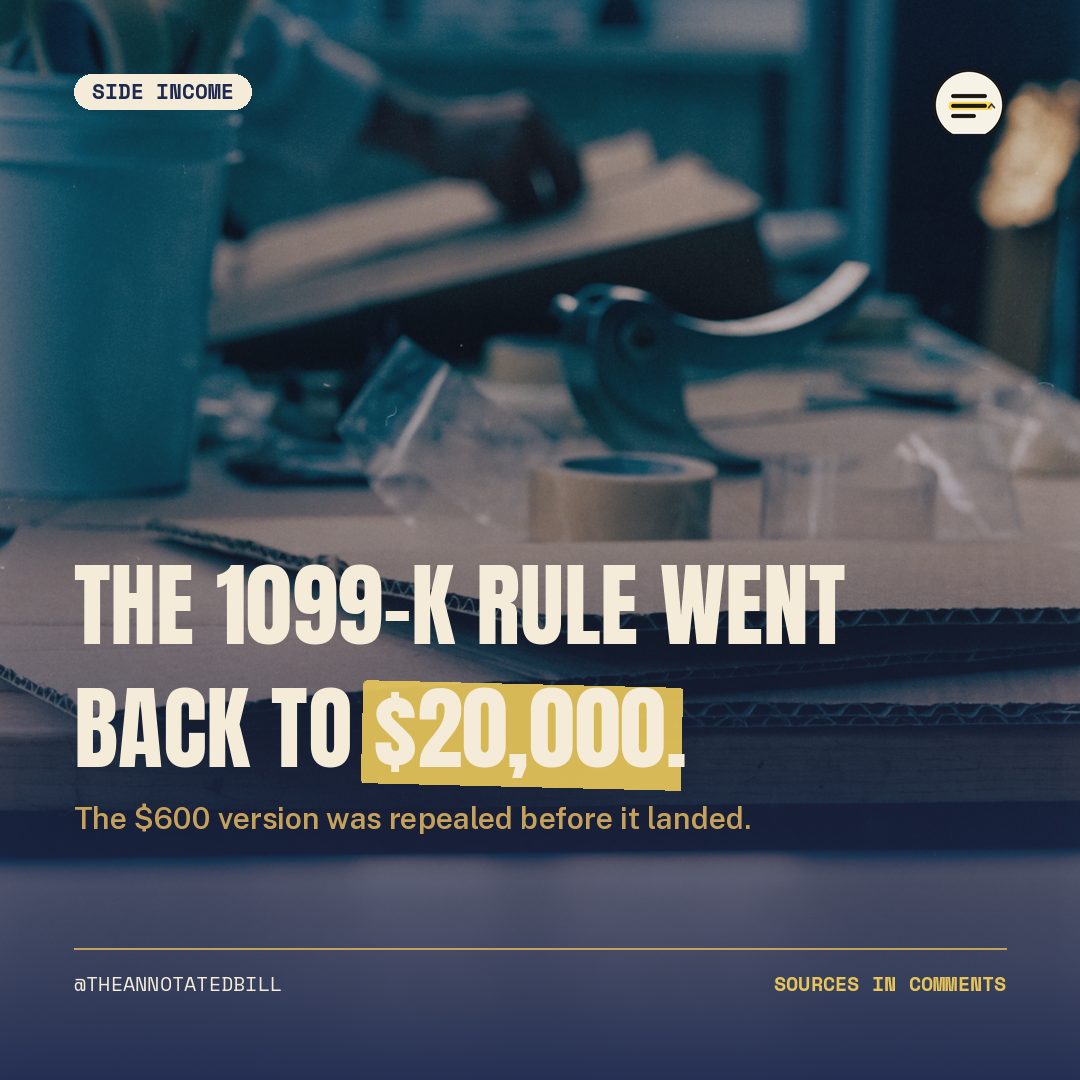
Two tests, and the word between them
A third-party settlement organisation — a payment app, an online marketplace, a card processor acting in that role — is not required to file a Form 1099-K unless the gross amount of reportable payments to a payee exceeds $20,000 and the number of transactions exceeds 200.
The thresholds are joined by and, not or IRS guidance implementing P.L. 119-21.
Margin noteThis is the whole design. A seller with $50,000 across 12 transactions files nothing. A seller with 400 transactions totalling $3,000 files nothing. Only crossing both lines triggers the form — which is what keeps casual sellers out of the system.
P.L. 119-21 reinstated these thresholds retroactively, rather than letting the lower one phase in.
A rule announced four times and applied never
The American Rescue Plan Act of 2021 lowered the 1099-K threshold to $600 with no transaction minimum. It was scheduled to take effect for the 2022 tax year.
It did not. The IRS delayed implementation, then delayed it again, then announced a phased approach — each time citing the volume of forms that would be generated and the confusion they would cause. In the end the provision was repealed before it was ever fully in force.

A form is not a tax bill
The objection was never that online sellers should not pay tax on their profits. It was that a $600 gross-payments threshold generates forms for enormous numbers of transactions that produce no taxable income at all.
If you sell a used couch for $400 that you bought for $900, you have a loss, not a gain, and you owe nothing. Under the $600 rule, enough such sales would still produce a form reporting gross proceeds — and the burden of explaining that the proceeds were not income would fall on the seller.

That is the structural flaw. 1099-K reports gross payments, not profit. For businesses the distinction is handled routinely in accounting. For a private individual clearing out a garage, it produces a tax document describing something that is not income.
The obligation was never about the form
Profit from selling goods or services is taxable whether or not a 1099-K arrives. Someone running a genuine resale business through a marketplace owes tax on the margin at $5,000 of sales exactly as at $50,000.
What the threshold governs is the reporting that makes compliance automatic. Above it, the IRS matches the form to the return. Below it, the system relies on self-reporting.
Both cases, in their own words
This site does not referee motives. Here is each side’s strongest version, at the same length and in the same register.
It targets businesses, not garage sales
Requiring both $20,000 and 200 transactions is a reasonable proxy for commercial activity. Supporters argue it captures the sellers the reporting regime was designed for without sweeping in everyone else.
The IRS said it could not absorb the volume
Repeated administrative delays were not political; the agency itself concluded the form volume and the resulting taxpayer confusion were unmanageable.
Gross proceeds are a bad proxy for income
A reporting form that routinely describes losses as though they were receipts creates compliance work with no revenue behind it.
Platform income is genuinely under-reported
Critics argue the gig and resale economy has grown far faster than the reporting regime covering it, and that restoring a 2008-era threshold leaves a large and growing amount of real business income outside automatic matching.
Two tests are easy to stay under
A seller who keeps transaction counts below 200 can clear substantial sums with no form generated at all.
It was repealed retroactively
Platforms that had already built systems for the lower threshold absorbed the cost of a rule that never took effect.
The honest framing was never about $600
The fight over 1099-K was a fight about what a tax form is for. One view treats it as a net cast as widely as possible. The other treats it as a tool aimed at commercial activity, whose cost is borne by everyone it misclassifies.
Congress
Set the $600 rule in 2021 and repealed it in 2025 without it ever being fully applied.
The IRS
Delayed it repeatedly on administrative grounds, which is unusual and was the clearest signal the design had a problem.
Sellers
Owe exactly what they owed throughout. Only the paperwork moved.
What is settled, for now: more than $20,000 and more than 200 transactions, both required, restored retroactively — and no form at all for the couch you sold at a loss.
Sources
Every claim above traces to one of these.
- P.L. 119-21 — retroactive reinstatement of the Form 1099-K reporting thresholds
- IRS revised Form 1099-K frequently asked questions reflecting the enacted thresholds
- Thresholds: gross payments exceeding $20,000 and more than 200 transactions, both required
- American Rescue Plan Act of 2021 — reduction of the threshold to $600 with no transaction minimum
- IRS transition-period announcements delaying implementation of the lower threshold
- Form 1099-K reports gross payment volume rather than net profit
Send it to someone who sells online
Every figure above is sourced. Pass it on with the sources attached.
Bronze health plans now come with an HSA
A quiet expansion, buried in a tax law.