The shield this bill pays for is one seventh of a shield
The shield this bill pays for is one seventh of a shield
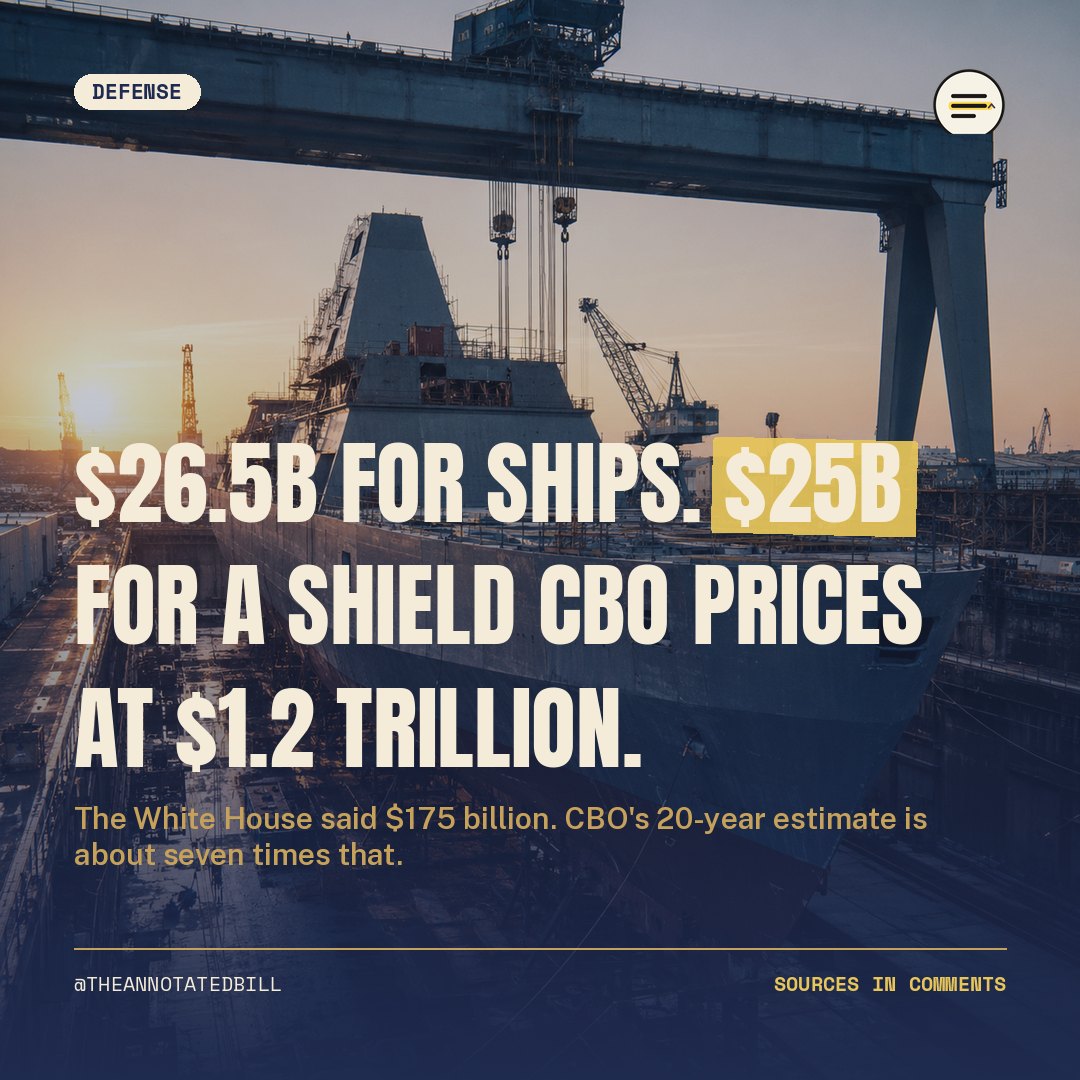
P.L. 119-21 put $150 billion into defense. Two line items tell you how the rest of the decade gets decided: $26.5 billion that buys 16 ships you can count, and $25 billion that starts a missile shield nobody has priced the same way twice.
$150B
Total defense funding in the reconciliation law
16
Battleforce ships bought outright
$25B
Golden Dome seed funding
$1.2T
CBO’s 20-year estimate for the full system
The short version
This breakdown went out as a carousel the same day. Same numbers, fewer words.
What a reconciliation bill is, and why defense is in one
P.L. 119-21 is a budget reconciliation law — the procedure that lets the Senate pass budget legislation on a simple majority instead of the sixty votes needed to break a filibuster. That procedural fact is why this law exists in the shape it does. It cleared the Senate 51–50, with the Vice President breaking the tie, and the House 218–214. Neither margin survives a single defection.
Reconciliation is normally associated with taxes and entitlements. This law also carried roughly $150 billion for defense — a second channel of defense money running alongside the ordinary annual appropriations process, as part of what the administration described as a “two bills, one budget” approach to fiscal 2026.
Defense money moved through reconciliation, not through the annual defense appropriations bill P.L. 119-21.
Margin noteAppropriations bills are annual, debated at length, and subject to the filibuster. Reconciliation runs once a year, on a simple majority, under strict time limits. Putting multi-year defense procurement in the second vehicle is legal and increasingly common — and it means the scrutiny that normally attaches to this spending happened faster, with less floor time.
$26.5 billion buys a list you can count
The shipbuilding line is the easiest money in this law to audit, because it converts directly into hulls. The $26.5 billion funds 16 battleforce ships.
What the money buys
- 1 Virginia-class attack submarine
- 2 Arleigh Burke-class guided-missile destroyers
- 1 America-class amphibious assault ship
- 1 San Antonio-class amphibious transport dock
- 9 Landing Ship Mediums
- 2 John Lewis-class fleet oilers
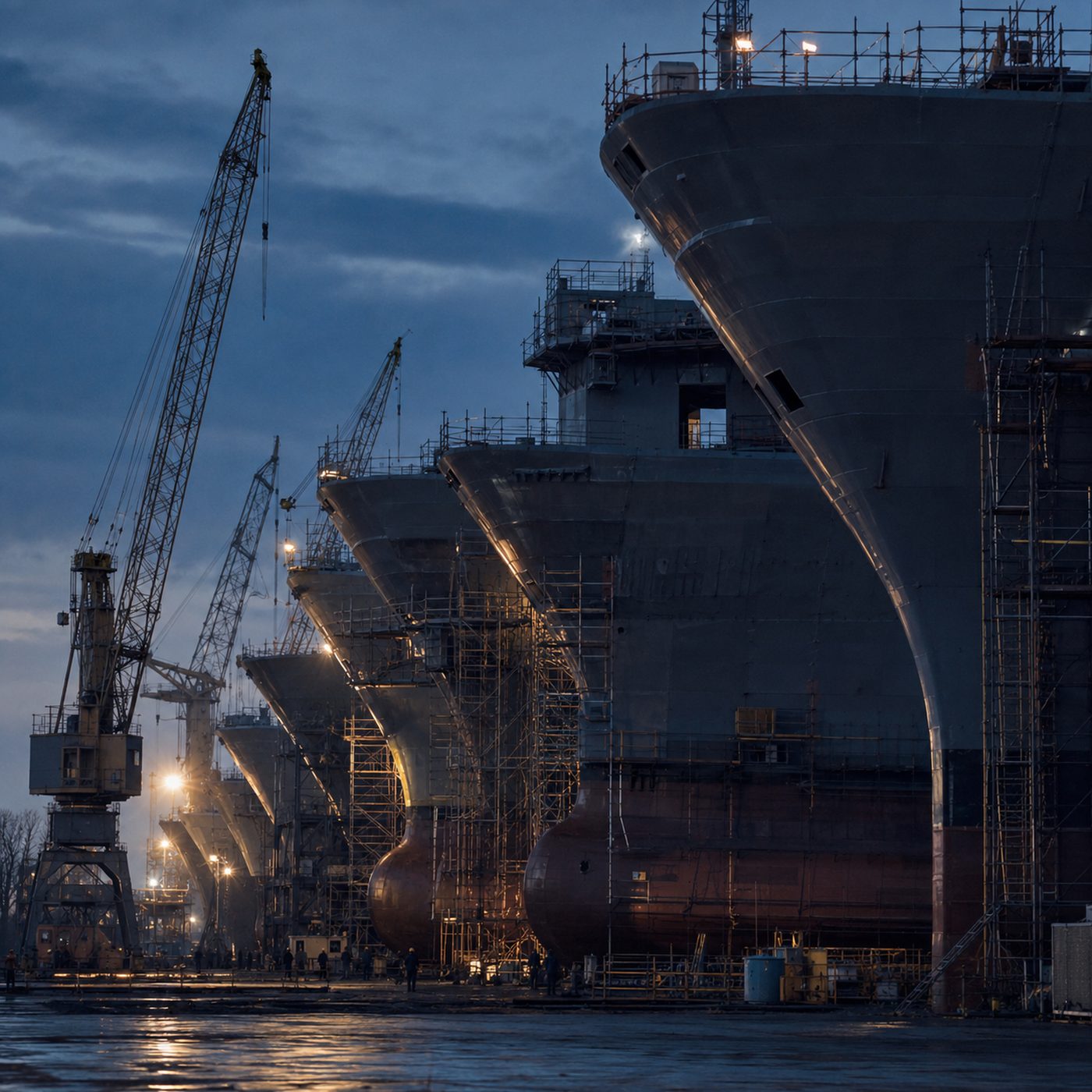
Ships have a property most defense spending does not: a yard, a hull number, and a delivery date. Whatever one thinks of the mix — nine of the sixteen are Landing Ship Mediums, a relatively small and new class — the money produces objects whose existence is verifiable.
Hold onto that, because the next line item does not work that way.
$25 billion is the first installment of something
Golden Dome is a proposed multi-layer missile defense system intended to detect and destroy ballistic, hypersonic and cruise missiles — in some configurations before they launch. It was announced by executive order in January 2025. The White House put the cost at $175 billion.
P.L. 119-21 appropriates $25 billion toward it. Against the administration’s own estimate, that is roughly one seventh of the program. The remaining six sevenths are not hidden, disputed, or buried in a footnote. They are simply not in this law. They arrive, if they arrive, in future appropriations passed by future Congresses under budget conditions nobody can forecast.
Seed funding is a normal and defensible way to begin a large program; almost every major defense system in American history started this way. But it changes what a vote means. A member voting for this provision voted for the opening installment of a program whose remaining cost is several times larger — and later installments are much harder to decline once the early money is spent and the contracts exist.
CBO priced the same architecture at $1.2 trillion
In May 2026 the Congressional Budget Office published its own estimate, using the January 2025 executive order as the blueprint. Its figure for a Golden Dome architecture consistent with that order: roughly $1.2 trillion over twenty years.
The space-based interceptor layer accounts for about 70% of acquisition costs and roughly 60% of total costs CBO.
Margin noteCBO’s modeling indicates full coverage of the United States, including Alaska and Hawaii, would require a constellation on the order of 7,800 satellites. That single engineering requirement is what separates a $175 billion program from a trillion-dollar one.
The gap between $175 billion and $1.2 trillion is not a rounding difference or a partisan dispute about priorities. It is a roughly sevenfold disagreement about what the same described system costs to build. Both numbers are on the public record. Only one of them existed when Congress voted.

America has run this experiment before. It was called Star Wars.
On March 23, 1983, Ronald Reagan announced the Strategic Defense Initiative: a program to research and deploy space-based and ground-based weapons capable of defending the United States against Soviet nuclear missiles. It was initially scoped as a six-year, $33 billion research program.
Over the following three and a half decades the federal government spent more than $239 billion (in 2016 dollars) on some version of that idea. In 1987 the American Physical Society concluded the necessary technologies were decades from readiness, and that another decade of research would be needed simply to know whether the system was possible. In May 1993 the Secretary of Defense announced the end of what he called the Star Wars era. No strategic missile shield was ever deployed.
The parallel is not a prediction. Technology that was impossible in 1983 is routine now, and cheap orbital launch is the single biggest reason anyone takes space-based interception seriously today. But the structural resemblance is exact: a presidentially announced shield, an opening price independent analysts immediately dispute, and a first appropriation that is small relative to the promise.
Both cases, in their own words
This site does not referee motives. Here is each side’s strongest version, at the same length and in the same register.
The threat changed
Hypersonic glide vehicles and advanced cruise missiles are designed specifically to defeat the interceptors the United States already fields. Supporters argue a defense built for the 1990s threat is not a defense, and that starting now is the only way to field anything in the 2030s.
Seed funding is how hard things start
No large system is fully funded at authorization. Appropriating $25 billion buys architecture studies, prototypes and industrial base — the work that makes a real cost estimate possible. Demanding a firm total before any money moves is a standard no major program has ever met.
Launch economics are genuinely new
Cost per kilogram to orbit has fallen by more than an order of magnitude since SDI. The constellation that was fantasy in 1983 is an engineering problem now.
The estimate problem
Congress voted with a $175 billion figure in hand. CBO’s independent estimate is roughly seven times that. Critics argue appropriating against a number that had not been independently validated is precisely how programs become unkillable: the money starts, the estimate corrects upward, and cancellation gets more expensive every year.
The physics moved less than the launch cost
Boost-phase interception from orbit requires interceptors overhead at the moment of launch, which is what drives the 7,800-satellite figure. Skeptics note the cheapest adversary response is more missiles, not better ones — and that defenses which can be saturated invite the buildup they were meant to deter.
Opportunity cost inside the same bill
The $26.5 billion shipbuilding line delivers 16 countable hulls. Critics ask what the $25 billion beside it delivers, and whether that comparison is the strongest argument against how it was funded.
The honest framing was never about the dome
When a legislature funds the first seventh of something, it has not made a $25 billion decision. It has made the first of several, and constrained all the later ones.
Congress
Appropriated the opening installment and can decline the next. It has rarely done so once a program has contracts and constituencies.
CBO
Has now put a competing number on the public record — a year after the vote, not before it.
The architecture
Is still undecided. The thing being priced does not yet exist in fixed form, which is why two estimates can differ sevenfold and both be defensible.
What is settled, for now: $150 billion for defense inside a reconciliation law, $26.5 billion converted into 16 ships, and $25 billion committed to a shield whose own sponsors and own budget office disagree about the price by roughly a trillion dollars.
Sources
Every claim above traces to one of these.
- P.L. 119-21 — FY2025 reconciliation law, defense title; signed July 4, 2025
- Senate vote 51–50 (Vice President breaking the tie); House vote 218–214
- Reconciliation defense total of approximately $150 billion
- Shipbuilding appropriation of $26.5 billion and the 16-ship battleforce list — USNI News, July 3, 2025
- Golden Dome executive order, January 2025
- White House cost estimate of $175 billion for Golden Dome
- Congressional Budget Office estimate, May 2026 — approximately $1.2 trillion over 20 years
- CBO cost concentration: space-based interceptor layer ~70% of acquisition, ~60% of total; ~7,800 satellites for full coverage
- Strategic Defense Initiative — announced March 23, 1983; initial six-year, $33 billion scope; more than $239 billion (2016 dollars) spent
- American Physical Society assessment (1987); Secretary of Defense announcement ending the SDI era, May 1993
Send it to someone who argues about defense spending
Every figure above is sourced. Pass it on with the sources attached.
“No tax on tips” is a deduction, not an exemption
A $25,000 ceiling, an income limit, and an expiration date nobody mentions.