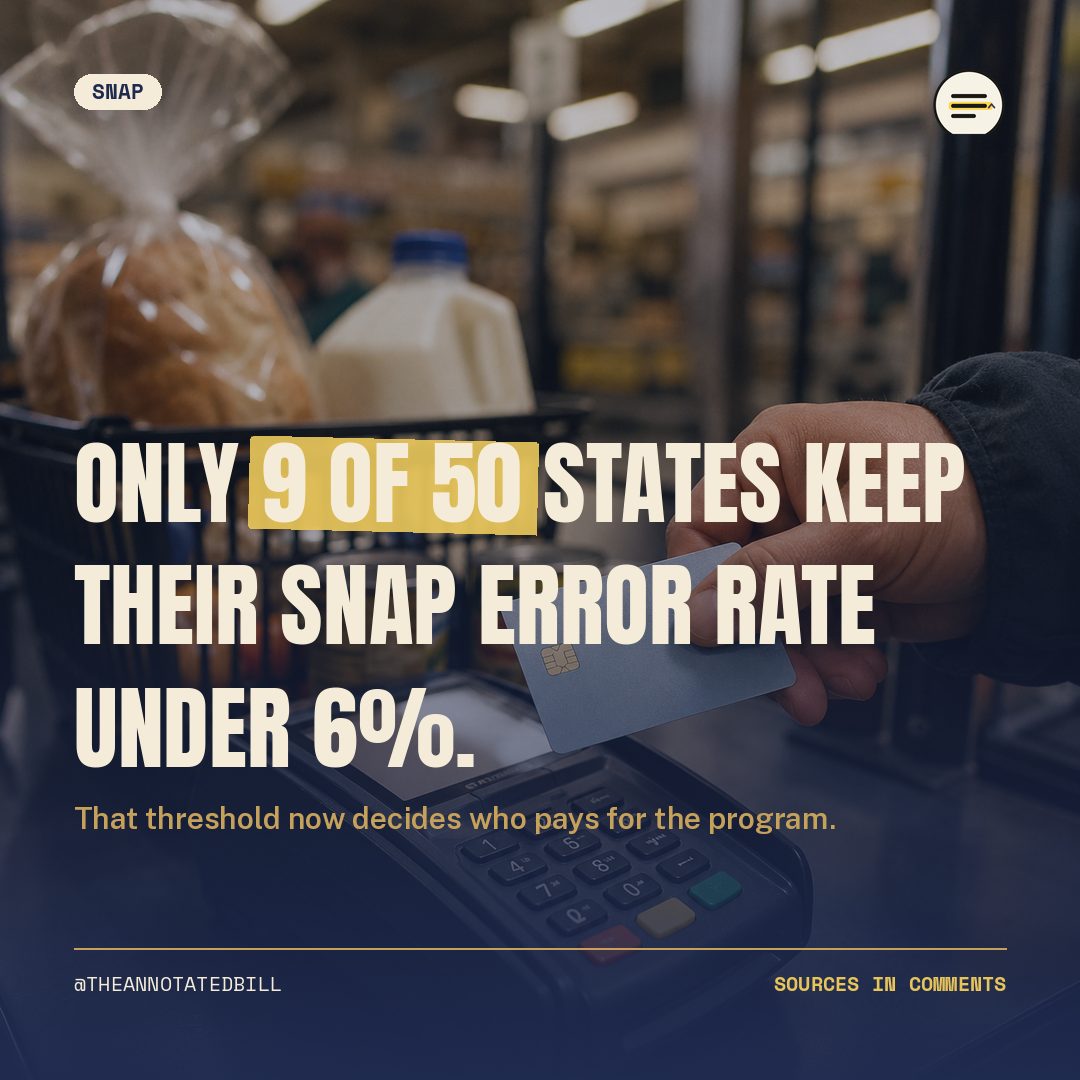
Only 9 of 50 states keep their SNAP error rate under 6%. That number now decides who pays.
Only 9 of 50 states are under 6%. That number now decides who pays.
SNAP benefits have always been federally funded. This law ties a share of that cost to each state’s payment error rate — a technical administrative statistic that most state budget offices had never treated as a budget line.
9 / 50
States under the 6% threshold
12.32%
Pennsylvania’s payment error rate
$270M
Upper-end estimate of Virginia’s exposure
~$15M
Estimated New Hampshire exposure
The short version
This breakdown went out as a carousel the same day. Same numbers, fewer words.
A threshold, not a cut
P.L. 119-21 establishes state cost-sharing in SNAP tied to each state’s payment error rate, using a 6% threshold. States above it take on a share of benefit costs that the federal government previously bore in full.
An error rate measures administrative accuracy, not fraud P.L. 119-21, SNAP cost-share provision.
Margin noteThe payment error rate captures overpayments and underpayments together — a household given $12 too little counts as an error exactly as one given $12 too much. It is a measure of how precisely a state’s caseworkers applied a complex benefit formula, and it has historically been used to target administrative improvement, not to allocate cost.
Nine states clear it
The decisive fact about a 6% threshold is where states actually sit. Only nine of fifty are below it. Pennsylvania’s rate is 12.32% — more than double the threshold.

Conventional estimates of state exposure put Virginia’s at up to $270 million and New Hampshire’s at roughly $15 million. Those figures are analytical estimates, not statutory numbers, and they will move as error rates are recalculated.
When a threshold is set at a level most of the regulated parties do not meet, the practical effect is a general cost shift with a performance label on it.
Federalising accuracy, not eligibility
SNAP has long been a shared-administration program: the federal government pays for benefits, and states share administrative costs and run the eligibility system. This law does not change who qualifies or what the benefit is worth. It changes who writes the cheque, based on how accurately the state administers it.

That is a real incentive, and that is the argument for it. The counter-argument is that error rates respond to caseload complexity and administrative funding as much as to effort, so a state with a harder caseload and a thinner agency can be penalised for conditions it does not fully control.
Both cases, in their own words
This site does not referee motives. Here is each side’s strongest version, at the same length and in the same register.
Accuracy has had no price
States administer the program but have not borne the cost of administering it imprecisely. Supporters argue attaching a cost is the only reliable way to improve accuracy.
The money is real either way
Overpayments are federal dollars delivered incorrectly. Supporters argue the status quo asked taxpayers in accurate states to absorb errors made elsewhere.
States can move the number
Unlike most cost-shift mechanisms, this one has a lever: a state that improves accuracy reduces its exposure.
Error is not fraud
The rate counts underpayments as well as overpayments. Critics argue a state can be penalised for errors that shortchanged recipients.
The threshold is below where almost everyone sits
With 41 of 50 states above 6%, critics argue the provision functions as a broad cost shift rather than a targeted accuracy incentive.
States may tighten access to lower the rate
The simplest way to reduce payment errors is to process fewer marginal cases. Critics argue the incentive may reduce enrollment rather than improve accuracy.
The honest framing was never about error rates
This provision does not change who is eligible for SNAP or how much they receive. It changes which government pays, and it uses an administrative statistic as the switch. That makes a measurement question into a budget question in fifty capitals at once.
The threshold
6%, which nine of fifty states currently meet.
The exposure
Estimated in the hundreds of millions for larger states; the figures are analytical, not statutory.
The benefit
Unchanged. Eligibility and benefit levels are set federally and are not altered by this mechanism.
What is settled, for now: state cost-sharing in SNAP keyed to a 6% payment error-rate threshold, with most states currently above it.
Sources
Every claim above traces to one of these.
- P.L. 119-21 — SNAP state cost-sharing provision keyed to a 6% payment error-rate threshold
- Count of nine states with payment error rates below 6%
- Pennsylvania payment error rate of 12.32%
- Conventional estimates of state exposure: up to $270 million for Virginia, approximately $15 million for New Hampshire (analytical estimates, not statutory figures)
- SNAP payment error rate methodology — includes both overpayments and underpayments
- CRS R48755, SNAP provisions in P.L. 119-21
Send it to someone who follows a state budget
Every figure above is sourced. Pass it on with the sources attached.
This law’s real structure is a calendar
Read the dates and the design becomes obvious.