The Supreme Court upheld the CFPB’s funding in 2024. Congress halved it in 2025.
The Supreme Court upheld this funding in 2024. Congress halved it in 2025.
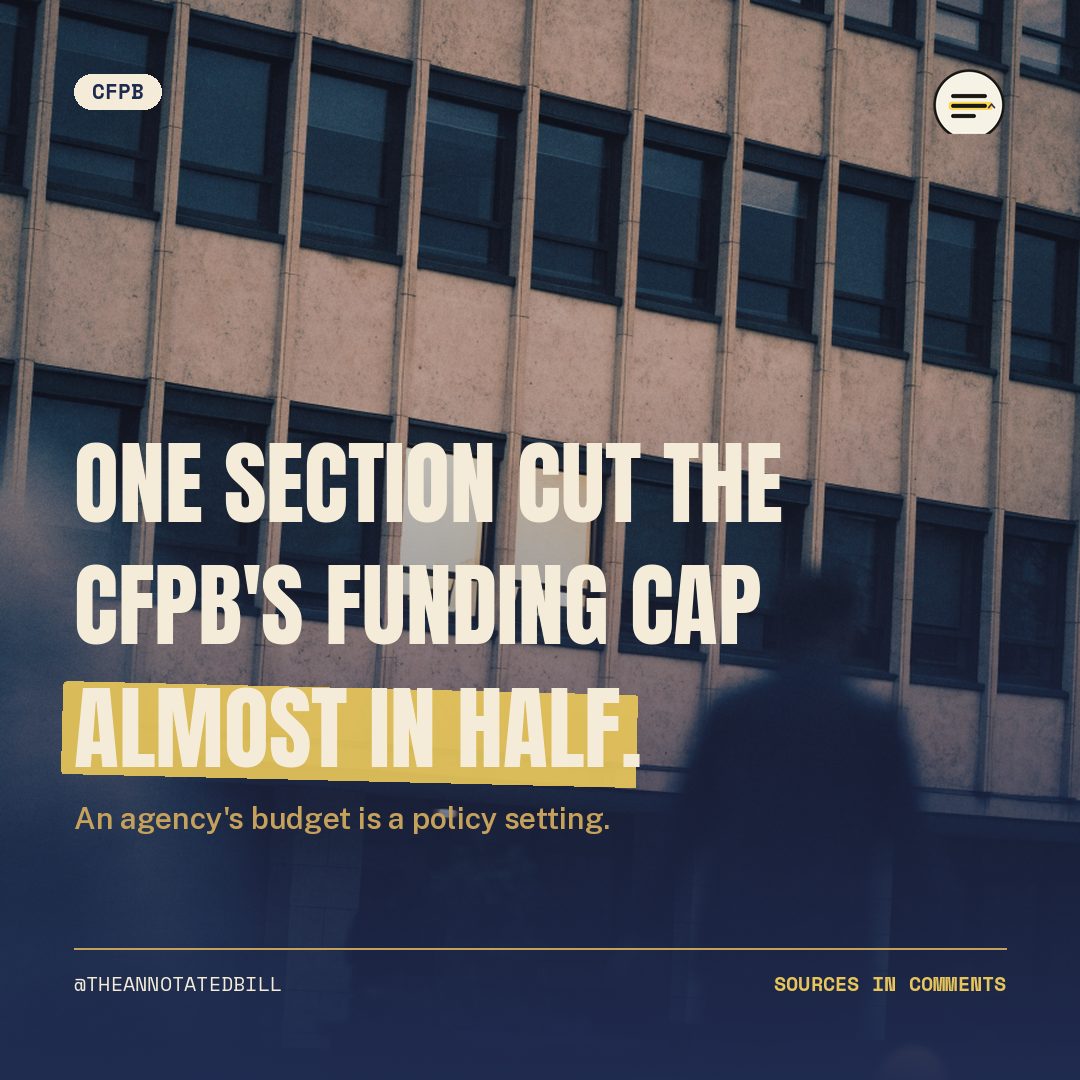
For a decade the CFPB’s funding structure survived every constitutional attack, up to and including a 7–2 Supreme Court ruling. Then one section of a tax-and-spending law cut the cap by nearly half — using the ordinary legislative power that was always available.
12% → 6.5%
The funding cap, before and after
FY2009
The benchmark year, fixed
7–2
Supreme Court vote upholding the structure
2010
Year the CFPB was created
The short version
This breakdown went out as a carousel the same day. Same numbers, fewer words.
One section, one number
Section 30001 of P.L. 119-21 reduced the Consumer Financial Protection Bureau’s funding cap from 12% to 6.5% of the Federal Reserve’s total operating expenses for fiscal year 2009.
The ceiling is pegged to a fixed historical figure — the Fed’s operating expenses in FY2009 CRS IN12578.
Margin noteThat number does not move. It does not track inflation, the Federal Reserve’s current budget, or the size of the consumer financial market the bureau supervises. Even before this cut, the real value of the ceiling declined every year. Halving the percentage accelerates a decline that was already built into the design.
A design choice from 2010
The CFPB was created by Title X of the Dodd-Frank Wall Street Reform and Consumer Protection Act of 2010. Unlike most federal agencies it does not receive an annual appropriation. It draws funds from the Federal Reserve up to a statutory ceiling.
That was deliberate. The intent was to insulate the bureau’s budget from the annual appropriations process, on the theory that a regulator of the financial industry should not depend on yearly funding votes that the industry could lobby.

Whether that insulation is appropriate has been contested since the day it was written, and it is a legitimate structural argument — agencies outside the appropriations cycle are harder for Congress to supervise.
The constitutional route was tried and failed
The funding structure was challenged as a violation of the Constitution’s Appropriations Clause. In Consumer Financial Protection Bureau v. Community Financial Services Association of America, decided May 16, 2024, the Supreme Court held 7–2 that the mechanism satisfies the Appropriations Clause, because it identifies a source of public money and a designated purpose.

That sequence is the most instructive thing about this provision. The constitutional challenge asked whether Congress may fund an agency outside the appropriations process. The Court said yes. Congress then exercised the ordinary legislative power that answer confirmed, and changed the number.
Both cases, in their own words
This site does not referee motives. Here is each side’s strongest version, at the same length and in the same register.
Budgets are Congress’s job
Supporters argue that if an agency sits outside annual appropriations, adjusting its statutory ceiling is the only oversight tool available — and using it is accountability, not retaliation.
The cap was generous by design
The bureau has operated below its ceiling in some years. Supporters argue a lower cap constrains growth without necessarily cutting current operations.
Insulation has costs
An agency that never has to justify a budget request faces less scrutiny than one that does.
A fixed 2009 benchmark shrinks automatically
Pegging the ceiling to seventeen-year-old expenses means the real budget falls each year with no further vote. Critics argue that is a cut that compounds silently.
It was done in a tax bill
A substantive change to financial regulation moved through a reconciliation package rather than through financial services legislation, with correspondingly little hearing time.
Supervision capacity is the output
Critics argue examination and enforcement capacity scales with budget, and that halving the ceiling is a decision about how much consumer financial supervision happens.
The honest framing was never about the CFPB
Funding structure is regulatory policy. How an agency gets its money determines how independent it is, how much it can do, and who can constrain it — and that question is separate from whether you think the agency is good at its job.
The courts
Settled that this funding method is constitutional, which left the amount entirely to Congress.
Congress
Used that authority in a tax-and-spending law rather than in financial regulation legislation.
The benchmark
Remains fixed at FY2009, so the ceiling keeps falling in real terms without further action.
What is settled, for now: a cap of 6.5% of the Federal Reserve’s FY2009 operating expenses, down from 12%, with the benchmark year unchanged.
Sources
Every claim above traces to one of these.
- P.L. 119-21 §30001 — reduction of the CFPB funding cap from 12% to 6.5% of the Federal Reserve’s FY2009 total operating expenses
- CRS IN12578, P.L. 119-21 Provisions Related to CFPB Funding
- Dodd-Frank Wall Street Reform and Consumer Protection Act of 2010, Title X — creation of the CFPB and its funding mechanism
- Consumer Financial Protection Bureau v. Community Financial Services Association of America, decided May 16, 2024
- 7–2 holding that the funding mechanism satisfies the Appropriations Clause
- Funding drawn from the Federal Reserve rather than through annual appropriations
Send it to someone who follows financial regulation
Every figure above is sourced. Pass it on with the sources attached.
$50 billion for rural health — if your state asks for it
More than 100 rural hospitals have closed since 2010.