The home solar credit is gone, and the deadline passed before most people noticed
The home solar credit is gone, and the deadline already passed
The residential clean energy credit covered solar panels and geothermal heat pumps for homeowners and renters. It is repealed for anything installed after calendar year 2025 — a deadline that arrived in the middle of a process that routinely takes months.
2025
Last year of qualifying expenditures
25D
The section repealed
Carry fwd
Unused credit already earned survives
0
Credit for new installations now
The short version
This breakdown went out as a carousel the same day. Same numbers, fewer words.
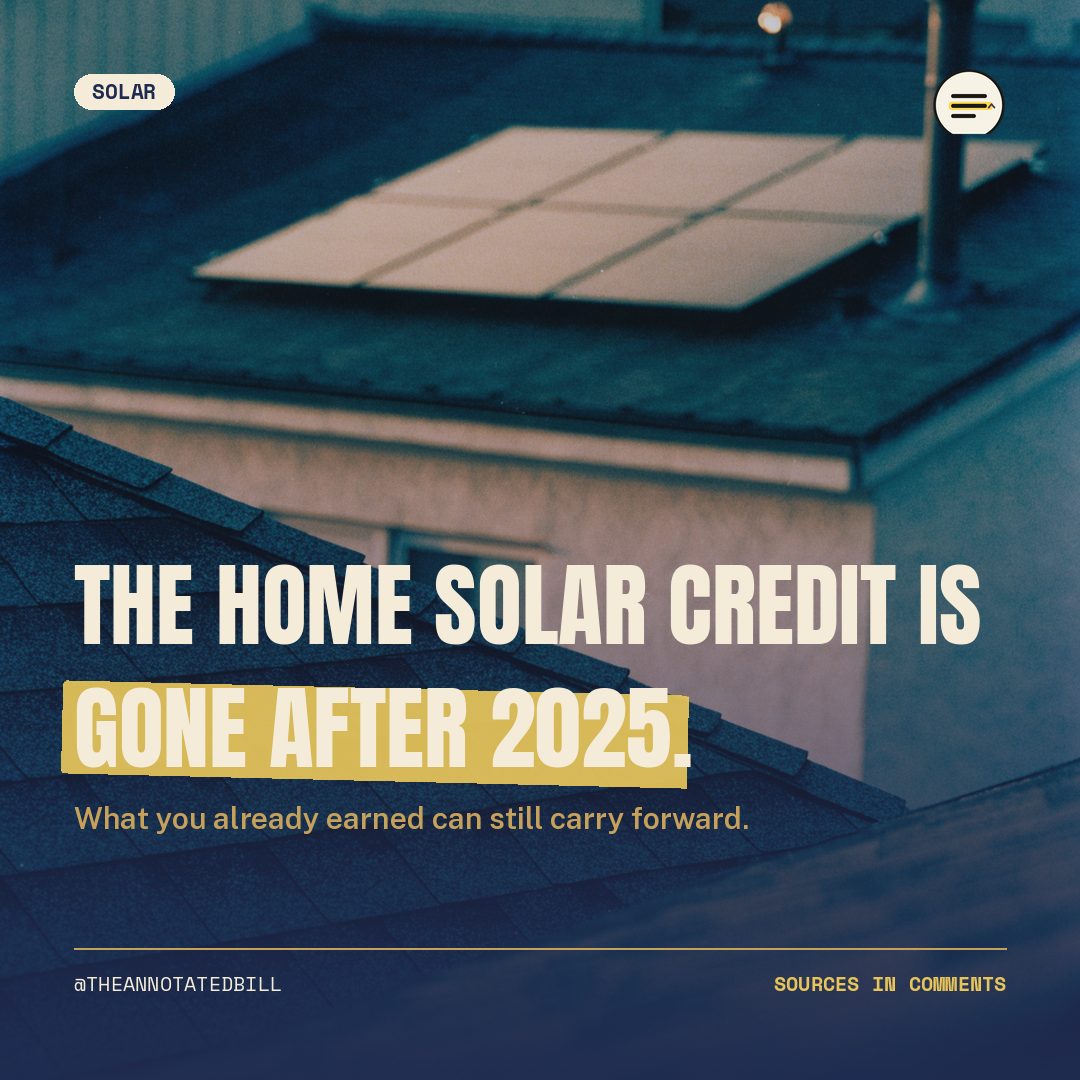
What was repealed, and what survives
The residential clean energy credit is repealed for expenditures made after calendar year 2025.
The credit covered home renewable energy equipment — solar electric panels, geothermal heat pumps and similar installations — and was available to homeowners and renters, though not to landlords.
Unused credit from qualifying pre-2026 expenditures can still be carried forward into later tax years CRS IN12611.
Margin noteThis distinction matters for anyone who installed in 2024 or 2025 but could not use the full credit against that year’s tax liability. The credit for new installations ends; credit already earned does not evaporate.
A deadline that arrived mid-process
Residential solar is not a same-week purchase. A typical process runs through site assessment, system design, financing, permitting, utility interconnection approval and installation scheduling — commonly several months, sometimes longer in jurisdictions with slow permitting.

A homeowner comparing quotes through 2025 needed the qualifying expenditure to land before the calendar year closed. Anyone still deliberating when the year ended lost the credit, generally without a clear signal that a cliff was approaching — the repeal was one provision inside a very large law that was covered mainly for other reasons.
This is a recurring feature of the energy provisions in P.L. 119-21: the deadlines are specific, consequential, and several of them are already in the past.
Twenty years of on-again, off-again
A federal credit for residential renewable energy was established by the Energy Policy Act of 2005, and it has been extended, expanded, allowed to lapse and restored repeatedly since. Most recently the Inflation Reduction Act of 2022 extended and enlarged it with a long runway.

That history is itself the policy problem. Residential solar economics depend on a payback period measured in years, and the federal subsidy underpinning the arithmetic has changed roughly every few years for two decades. Households are being asked to make a fifteen-year decision against a tax provision with a three-year memory.
Both cases, in their own words
This site does not referee motives. Here is each side’s strongest version, at the same length and in the same register.
The technology no longer needs it
Panel costs have fallen dramatically since 2005. Supporters argue a subsidy designed to bootstrap an infant industry should end when the industry matures, and that continuing it transfers money to purchases that would happen anyway.
It is regressive in practice
A non-refundable credit for a capital purchase flows to households with both the tax liability to use it and the means to install. Renters and lower-income homeowners largely could not access it.
The carry-forward protects existing claims
Nobody who already qualified loses credit they earned.
The deadline was effectively retroactive
Given typical installation timelines, repealing the credit for post-2025 expenditures stranded households already in the middle of a purchase they had budgeted around it.
Policy whiplash raises the cost of capital
Installers and lenders price uncertainty. Critics argue two decades of stop-start subsidies have done more damage to cost than the subsidy itself delivered in benefit.
It ends the credit at the worst moment for electricity prices
Removing support for distributed generation while retail electricity costs rise shifts the burden to households without the option.
The honest framing was never about solar
This provision is a case study in what happens when a long-horizon household investment depends on a short-horizon tax provision. The policy question is not only whether the credit should exist but whether a subsidy that changes every few years can do the job it was designed for.
Congress
Has set, extended, lapsed and repealed this credit repeatedly since 2005.
Households
Who installed before the end of 2025 keep their credit, including unused amounts carried forward.
Everyone else
Now faces unsubsidised pricing, with no federal credit for new installations.
What is settled, for now: no residential clean energy credit for expenditures after calendar year 2025, with carry-forward preserved for credit already earned.
Sources
Every claim above traces to one of these.
- P.L. 119-21 — repeal of the residential clean energy credit for expenditures made after calendar year 2025
- CRS IN12611, Expiration and Carryforward Rules for the Residential Clean Energy Credit
- Coverage of solar electric panels, geothermal heat pumps and similar equipment; availability to homeowners and renters but not landlords
- Carry-forward of unused credit from qualifying pre-2026 expenditures
- Energy Policy Act of 2005 — establishment of the residential renewable energy credit
- Inflation Reduction Act of 2022 — extension and expansion of the credit prior to this repeal
Send it to someone who was getting solar quotes
Every figure above is sourced. Pass it on with the sources attached.
The consumer EV credit didn’t get cut. It already expired.
Several of this law’s deadlines are behind us, not ahead.