A reconciliation bill created Grad PLUS in 2005. A reconciliation bill just ended it.
A reconciliation bill created Grad PLUS. A reconciliation bill just ended it.
For twenty years graduate students could borrow up to the full cost of attendance from the federal government. Research found universities captured most of that money through higher tuition. This law caps borrowing and removes the program.
$100,000
Lifetime cap, graduate students
$200,000
Lifetime cap, professional students
64%
Of added Grad PLUS borrowing captured by tuition
2006
Year Grad PLUS reached graduate students
The short version
This breakdown went out as a carousel the same day. Same numbers, fewer words.
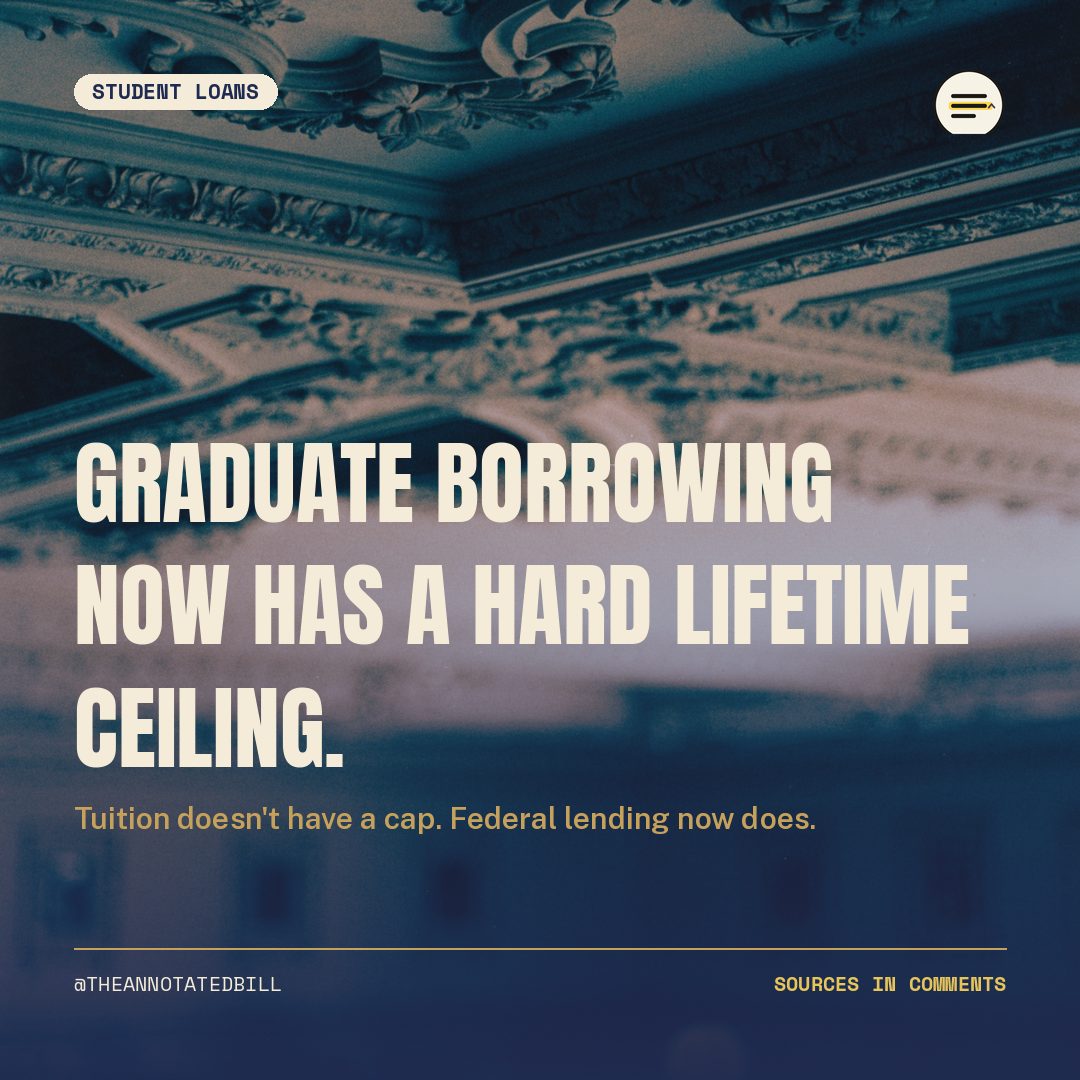
Two caps and a closure
P.L. 119-21 sets new federal borrowing limits. Graduate students may borrow $20,500 a year with a $100,000 lifetime aggregate. Professional students — medicine, law, dentistry — may borrow $50,000 a year with a $200,000 aggregate.
Separately, Grad PLUS is eliminated for new borrowers as of July 1, 2026. Every other Direct Loan type is retained.
Grad PLUS was the program that covered whatever the annual limits did not CRS IN12585.
Margin noteCapping annual and lifetime borrowing while leaving Grad PLUS in place would have changed little, because Grad PLUS could fill the gap. Removing Grad PLUS while leaving the old limits would have left a different gap. Doing both closes the federal lending envelope entirely.
Created in a reconciliation bill, ended by one
Grad PLUS was created by the Deficit Reduction Act of 2005 — itself a budget reconciliation bill — and extended to graduate and professional students on July 1, 2006. It allowed borrowing up to the full cost of attendance as determined by the institution, with essentially no fixed ceiling.

The symmetry is exact. A program created in a reconciliation bill to save money on student lending has been ended by another reconciliation bill, twenty years later, for the same stated reason.
What the research found about unlimited lending
The strongest argument for these caps is not ideological. It is empirical, and it is about where the money went.
Research on the period after Grad PLUS was introduced found that students more exposed to the change increased their borrowing by more than $6,000 — and that institutions captured most of it through higher graduate tuition. Roughly 64% of the additional borrowing went into institutional revenue. Access to graduate programs did not measurably rise.

If that finding holds, unlimited federal lending functioned less as aid to students than as a mechanism allowing tuition to rise, with students carrying the debt. That is the clearest case for a cap, and it does not depend on any view about whether graduate education is worth the money.
Tuition does not have a ceiling
Capping federal lending does not reduce what programs charge, at least not immediately. In the near term the gap between the cost of attendance and the federal limit has to be financed some other way.
That other way is the private loan market: no income-driven repayment, no federal forgiveness programs, underwriting based on credit and often a co-signer, and generally higher rates. For students entering expensive professional programs, the effect may be to change who holds the debt rather than how much there is.
Whether tuition responds over time is the open empirical question, and it is the same question in reverse — if institutions captured the money when lending expanded, they may have to give some of it back when lending contracts.
Both cases, in their own words
This site does not referee motives. Here is each side’s strongest version, at the same length and in the same register.
Unlimited lending removed price discipline
If a school can raise tuition knowing federal loans will cover any amount, there is no market constraint. Caps restore one, and the research on Grad PLUS suggests the effect was real.
The debt burden fell on students
The programs with the largest Grad PLUS balances have produced borrowers with six-figure debt and uncertain earnings. Supporters argue a ceiling protects students from a choice the system encouraged.
It is a cap, not a cut
$100,000 and $200,000 are substantial. Most graduate programs remain fully financeable within the limits.
It shifts debt to a worse market
Private loans lack income-driven repayment and forgiveness. Critics argue the cap changes the lender, not the cost, and makes the terms worse.
It falls hardest on students without family money
A student whose family can cover the gap is unaffected. One who cannot may be excluded from the program entirely.
Professional school costs exceed the caps
Some medical and dental programs cost more than $200,000 in total. Critics argue the cap is set below the actual price of the training the country says it needs.
The honest framing was never about the caps
The question underneath this provision is who should bear the risk of expensive graduate education: the federal government through unlimited lending, the student through private debt, or the institution through pricing discipline. This law moves the answer away from the first option without specifying which of the other two takes it up.
Congress
Closed a program it created in a reconciliation bill twenty years earlier, citing the same budget logic.
Institutions
Captured most of the additional borrowing when lending expanded. Whether they absorb the contraction is the test of the policy.
Students
Face a hard federal ceiling from July 2026, with the private market beyond it.
What is settled, for now: $20,500 a year and $100,000 lifetime for graduate students, $50,000 and $200,000 for professional students, and no Grad PLUS for new borrowers after July 1, 2026.
Sources
Every claim above traces to one of these.
- P.L. 119-21 — graduate and professional borrowing limits and elimination of Grad PLUS for new borrowers as of July 1, 2026
- CRS IN12585, Student Loan Types and Limits in the FY2025 Budget Reconciliation Law
- CRS R48727, Amendments to the Higher Education Act Made by P.L. 119-21
- Deficit Reduction Act of 2005 — creation of Grad PLUS; extension to graduate and professional students July 1, 2006
- Grad PLUS permitted borrowing up to the institution’s cost of attendance
- Research finding affected students increased borrowing by more than $6,000 following the introduction of Grad PLUS
- Finding that roughly 64% of the additional borrowing was captured by institutions through higher graduate tuition, with no measurable increase in access
Send it to someone applying to graduate school
Every figure above is sourced. Pass it on with the sources attached.
The home solar credit is gone after 2025
The credit dates to 2005. Its deadline passed before most people noticed.