The SALT deduction is 113 years old. The cap on it is eight.
The SALT deduction is 113 years old. The cap on it is eight.
Deducting state and local taxes has been part of the federal income tax since the beginning. It was capped for the first time in 2017. This law quadruples the cap for four years, then puts it back.
$40,000
Cap for tax year 2025
1913
Year the deduction was created
2017
First time it was ever capped
$10,000
Where it returns in 2030
The short version
This breakdown went out as a carousel the same day. Same numbers, fewer words.
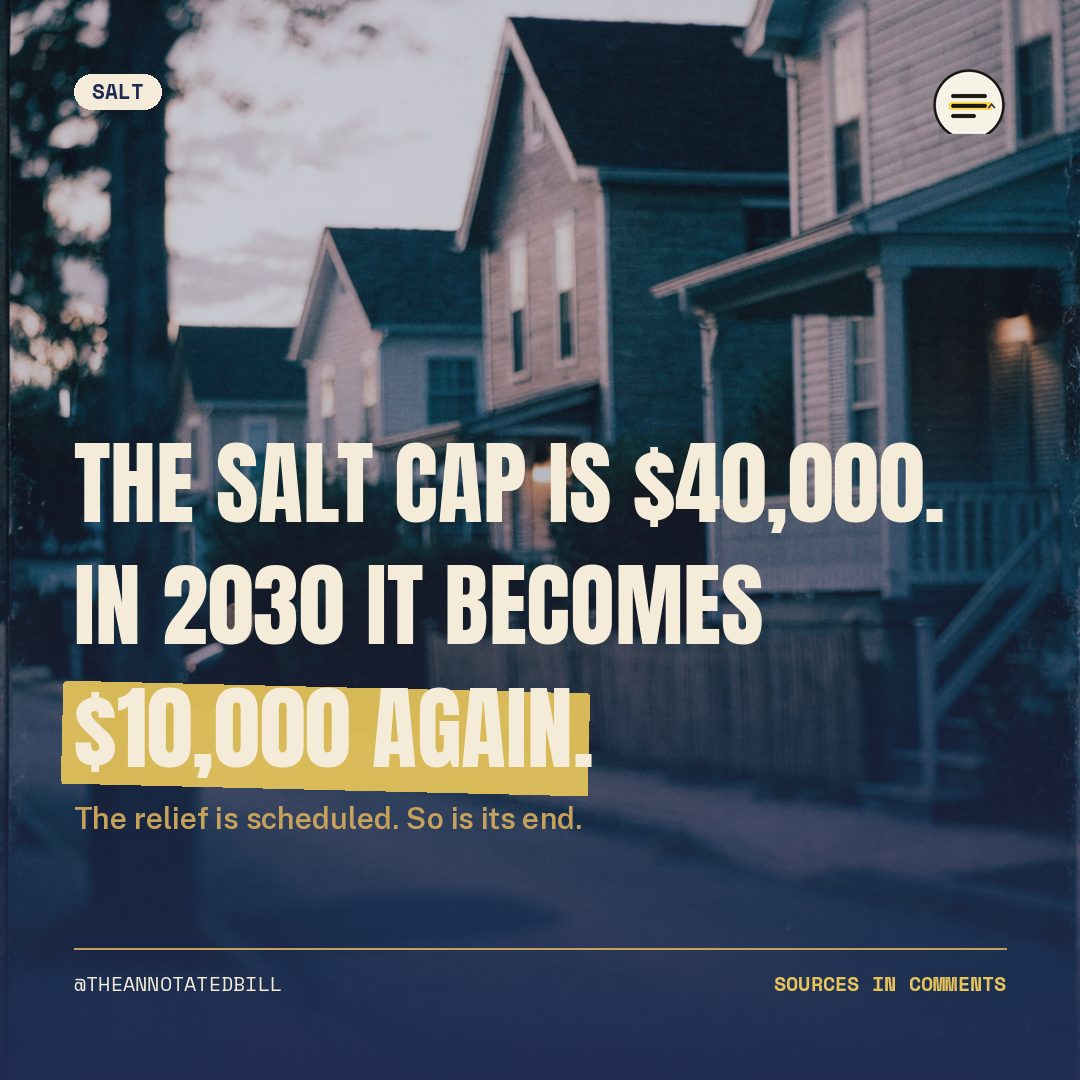
Four years up, then back down
The cap on deducting state and local taxes is $40,000 for most taxpayers in tax year 2025. It rises annually for 2026 through 2029. Beginning in 2030 it resets permanently to $10,000.
The increase and its reversal were enacted on the same day, in the same statute CRS R48611.
Margin noteThis is not a provision that might be revisited later. The return to $10,000 is already statutory text. Anyone planning around the higher cap is planning around a four-year window with a known end date.
Deductible since there was an income tax
The state and local tax deduction has existed since 1913, when the Sixteenth Amendment made a federal income tax constitutional. The original provision was broad, allowing deductions for all national, state, county, school and municipal taxes paid within the year, excluding those assessed against local benefits.
The Revenue Act of 1964 narrowed it to a list — income taxes, real property taxes, personal property taxes and sales taxes — disallowing other state and local taxes.
It was never capped at all until the Tax Cuts and Jobs Act of 2017 imposed a $10,000 limit for 2018 through 2025.

That 2017 cap was contentious enough that four of the most affected states — New York, Connecticut, New Jersey and Maryland — sued the federal government, arguing the cap was unconstitutional or unconstitutionally coercive of their fiscal choices. The litigation did not succeed, but it indicates how substantial the change was after a century of unlimited deductibility.
Why temporary relief is its own kind of policy
Expiration dates in reconciliation bills are usually about budget scoring: a provision that sunsets costs less inside the ten-year window used to measure the bill.

The practical consequence is a particular kind of policy. Relief arrives, is felt, becomes the baseline households plan around — property purchases, state tax planning, decisions about where to live — and then expires on schedule. At that point its removal is experienced as a tax increase, even though no new vote was taken.
That dynamic is the reason the 2030 date matters more than the $40,000 figure.
Both cases, in their own words
This site does not referee motives. Here is each side’s strongest version, at the same length and in the same register.
It prevents double taxation
Money paid to a state in taxes is not income available to the taxpayer. Supporters argue taxing it federally taxes the same dollar twice, which was the original rationale in 1913.
It reaches middle-income households in high-cost states
A $10,000 cap is quickly exceeded by property tax alone in parts of the country. Supporters argue the cap functioned as a geographic tax increase, not a tax on the wealthy.
Federalism
An uncapped deduction leaves states free to set their own tax and spending levels without federal penalty.
The benefit concentrates at the top
Only itemizers benefit, and the value rises with marginal rate and with the size of the state tax bill. Critics argue raising the cap is among the most upward-skewed changes in the law.
It subsidises high-tax jurisdictions
Deductibility shifts part of the cost of state and local taxation onto the federal government, and therefore onto taxpayers in other states.
The four-year window is the worst of both
Critics note that temporary relief delivers the revenue cost without the planning certainty, and guarantees another fight in 2029.
The honest framing was never about $40,000
For 104 years this deduction had no cap. For the last eight it has had one. The question now is not what the cap should be but whether a number that changes every few years can function as tax policy at all.
Congress
Set the increase and its expiry in a single statute, which makes 2029 the next scheduled fight.
High-tax states
Get four years of relief and then the same cap that prompted litigation in 2017.
Taxpayers
Face a planning horizon of four years on a decision — where to live, what to own — that usually runs much longer.
What is settled, for now: $40,000 for 2025, annual increases through 2029, and a permanent reset to $10,000 beginning in 2030.
Sources
Every claim above traces to one of these.
- P.L. 119-21 — SALT deduction cap of $40,000 for tax year 2025, annual increases 2026–2029, permanent reset to $10,000 from 2030
- CRS R48611, Tax Provisions in P.L. 119-21
- Origin of the state and local tax deduction in the Revenue Act of 1913 following ratification of the Sixteenth Amendment
- Revenue Act of 1964 — narrowing of deductible taxes to income, real property, personal property and sales taxes
- Tax Cuts and Jobs Act of 2017 — first-ever cap on the SALT deduction, $10,000 for 2018 through 2025
- Litigation brought by New York, Connecticut, New Jersey and Maryland challenging the 2017 cap
Send it to someone in a high-tax state
Every figure above is sourced. Pass it on with the sources attached.
The child tax credit went up $200 — and this one is permanent
In a law full of four-year deductions, the absence of an end date is the story.