From 2028, ACA coverage stops renewing itself
From 2028, ACA coverage stops renewing itself
Subsidised marketplace enrollees have been re-enrolled automatically each year. This law ends that. Everyone will have to actively verify income before open enrollment closes, every year, or lose the subsidy.
2028
First plan year affected
Every year
Frequency of required re-verification
PTC
The subsidy at stake
0
Automatic renewals remaining
The short version
This breakdown went out as a carousel the same day. Same numbers, fewer words.
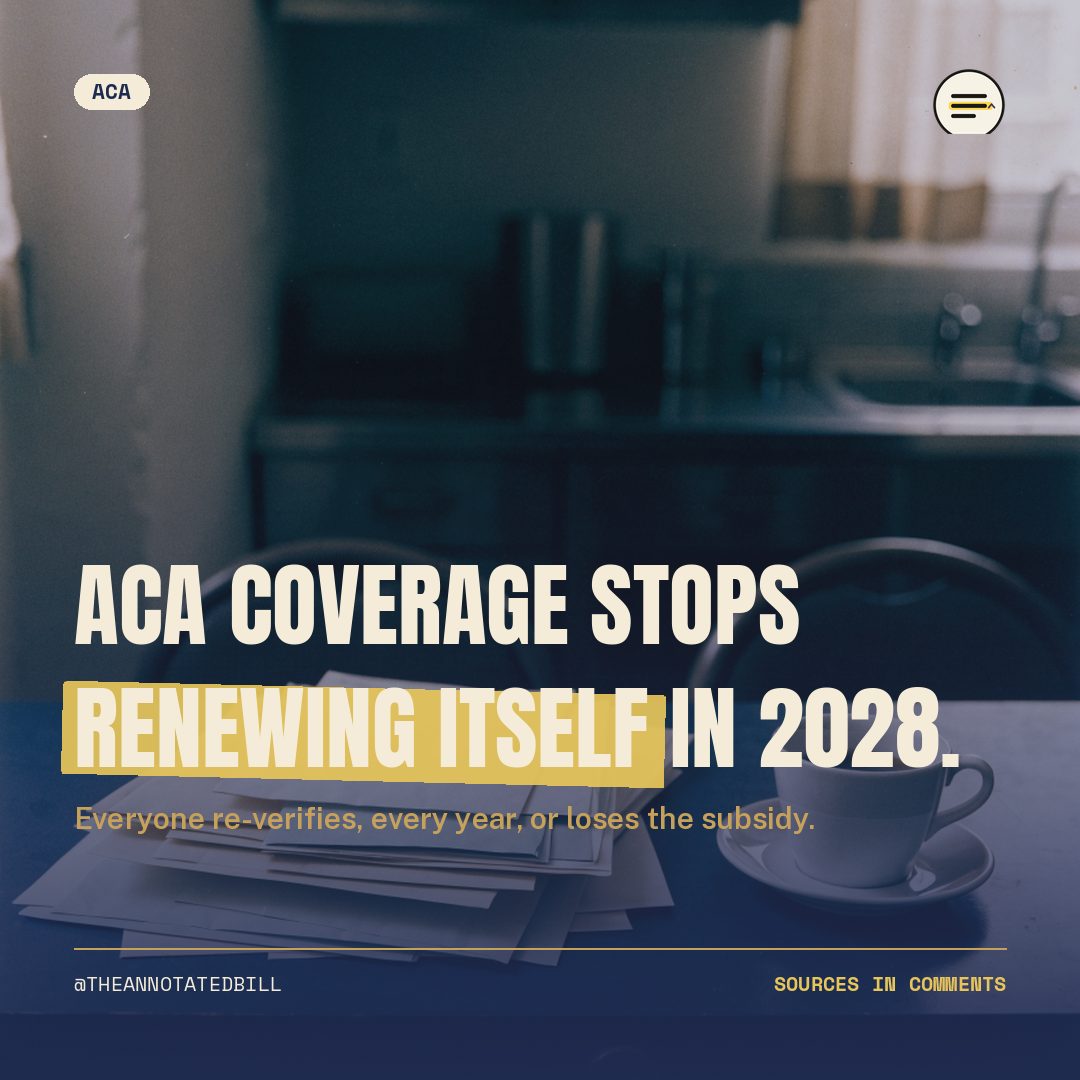
What ends, and when
Section 71303 of P.L. 119-21 ends the practice of automatically re-enrolling subsidised marketplace consumers in their existing plan, beginning with plan year 2028.
Enrollees must take actionable steps to verify income and other information each year before open enrollment closes P.L. 119-21 §71303.
Margin noteVerification is a precondition for receiving premium tax credits or cost-sharing reductions. Missing it does not merely delay the subsidy — it means the subsidy does not apply, which for most enrollees means the plan becomes unaffordable.
The stated rationale is program integrity: annual verification reduces subsidy payments to people whose circumstances have changed.
Administrative burden is a policy instrument
Requiring an affirmative step each year is not a neutral administrative detail. It is a filter, and it is worth being precise about what it filters for.

People who fail an annual paperwork deadline are not primarily people who have become ineligible. They are disproportionately people who moved and did not receive the notice, who work irregular hours, who have limited English, who lack stable internet access, or who simply did not know a deadline existed. Eligibility and the capacity to document eligibility on schedule are different things, and the second is not distributed evenly.
That is the core design question here, and it is independent of what one thinks about program integrity: a verification requirement removes some people who should not be receiving a subsidy, and some people who should.
There is recent evidence about what this does
The United States ran a large natural experiment in procedural disenrollment during the Medicaid eligibility redeterminations that followed the end of the pandemic-era continuous coverage requirement. A substantial share of the people who lost Medicaid in that period were disenrolled for procedural reasons — paperwork not returned, notices not received — rather than because they had been determined ineligible.

That episode is the closest available evidence for what annual marketplace verification will produce, and it is the reason the timing matters. Plan year 2028 gives states, exchanges and insurers roughly two years to build notification and verification systems that work better than the ones used in the Medicaid unwinding.
Both cases, in their own words
This site does not referee motives. Here is each side’s strongest version, at the same length and in the same register.
Subsidies should track current circumstances
Income changes. Automatic re-enrollment can continue a subsidy calibrated to a situation that no longer exists, which produces both overpayments and reconciliation problems for the enrollee at filing.
Annual contact is normal elsewhere
Employer coverage has open enrollment; other means-tested programs require periodic redetermination. Supporters argue annual engagement is a reasonable condition for a substantial public subsidy.
Two years is real lead time
A 2028 effective date allows exchanges to build and test the verification process rather than improvising it.
The evidence points one way
The Medicaid unwinding showed that procedural disenrollment reaches large numbers of still-eligible people. Critics argue the outcome here is predictable from that record.
Coverage losses are not costless
People who lose subsidised coverage generally do not stop needing care. The cost reappears as uncompensated care and delayed treatment, usually at higher total expense.
It targets the subsidy, not the fraud
Critics argue existing reconciliation at tax filing already recovers excess credits, making an annual re-verification requirement a blunt instrument for a problem with an existing remedy.
The honest framing was never about verification
Almost nobody argues that ineligible people should receive subsidies. The argument is about what a verification requirement costs in coverage among people who are eligible, and whether that trade is worth making.
Congress
Set the rule and the 2028 date, leaving the operational design to the exchanges.
The exchanges
Will determine the real outcome through notice design, deadlines and how much verification can be done automatically from existing data.
Enrollees
Carry a new annual obligation whose consequence for missing it is loss of the subsidy, not a reminder letter.
What is settled, for now: automatic re-enrollment ends with plan year 2028, and premium tax credits and cost-sharing reductions require affirmative annual verification before open enrollment closes.
Sources
Every claim above traces to one of these.
- P.L. 119-21 §71303 — end of automatic re-enrollment for subsidised marketplace enrollees beginning plan year 2028
- Requirement that enrollees verify income and other information annually before the close of open enrollment as a condition of receiving premium tax credits or cost-sharing reductions
- CRS R48633, Health Provisions in P.L. 119-21
- Medicaid continuous-coverage unwinding — procedural disenrollments following the end of the pandemic-era requirement
- Existing reconciliation of advance premium tax credits at tax filing
Send it to someone on a marketplace plan
Every figure above is sourced. Pass it on with the sources attached.
SNAP work rules now reach age 64
The limit was 49 until 2023. It has moved twice in three years.