Congress has been fighting this Medicaid financing trick since 1991
Congress has been fighting this Medicaid financing trick since 1991
States tax hospitals, pay the money back as Medicaid payments, and claim the federal match on the way through. Washington has been trying to close that circle for thirty-five years. This law freezes it and starts ratcheting it down.
1991
First major federal crackdown
25%
Cap on provider taxes as a share of the state match
FY2028
When expansion-state rate cuts begin
0
New provider taxes permitted
The short version
This breakdown went out as a carousel the same day. Same numbers, fewer words.
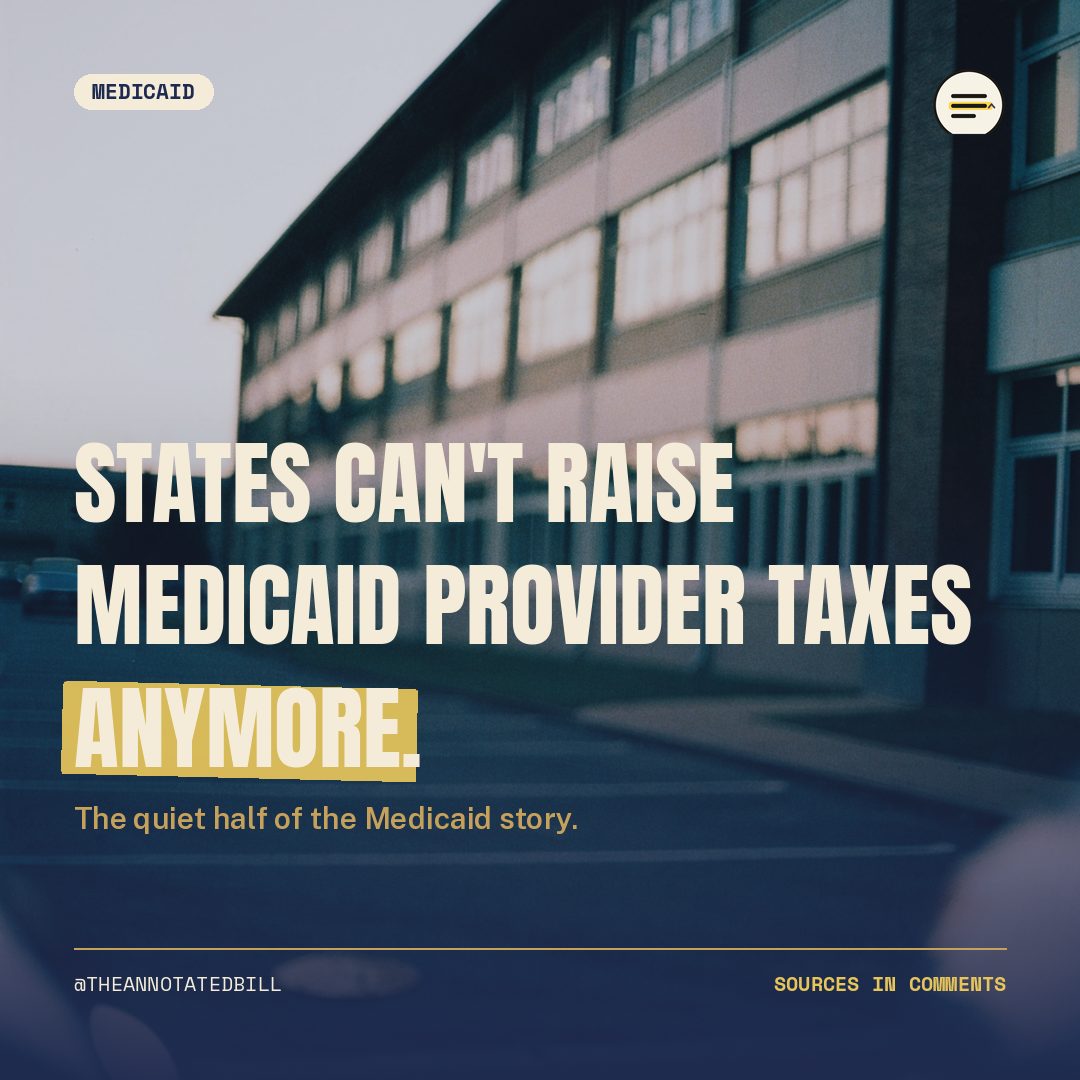
How a provider tax actually works
Medicaid is jointly funded. States pay a share; the federal government matches it. Provider taxes are how many states raise their share.
The structure is circular by design. A state taxes hospitals or nursing facilities, uses the revenue to fund its Medicaid match, and pays providers higher Medicaid rates. Providers are generally made more than whole by the higher payments; the state books a larger federal match; nobody in the circle is worse off except the federal treasury.
States were effectively borrowing their required match from the providers and returning it CRS RS22843.
Margin noteOnce the state share is netted out, the federal matching funds can be used to raise provider rates, fund other parts of Medicaid, or free state money for entirely unrelated purposes. That is the behaviour Congress has legislated against repeatedly.
The 1991 law, and why it did not settle anything
By the late 1980s some states were using provider taxes and donations aggressively enough to become a serious federal-state dispute. Congress responded with the Medicaid Voluntary Contribution and Provider-Specific Tax Amendments of 1991.
That law set three conditions that still govern. A provider tax must be broad based and uniformly applied across a class of providers, so a state cannot tax only Medicaid providers. It cannot exceed 25% of the state’s non-federal share of Medicaid spending. And states cannot guarantee, directly or indirectly, that providers are held harmless — made whole for the tax.

Those rules constrained the practice without ending it, because the underlying incentive never changed: a state that can convert its own tax revenue into federal matching dollars has every reason to do so, and the federal government has no equivalent reason to allow it.
Freeze, then ratchet
Section 71115 of P.L. 119-21 takes a different approach from 1991. Rather than tightening the conditions, it stops the practice where it stands.
It places a moratorium on new health-care-related taxes in Medicaid, freezes existing provider tax rates at current levels, and from FY2028 incrementally reduces the maximum allowable rates in Medicaid expansion states.

This is the provision to read alongside the Medicaid work requirement, not separately from it. One decides who remains eligible for coverage. This one decides what states can afford to pay for the coverage of everyone who remains eligible. Only one of them was widely covered.
Both cases, in their own words
This site does not referee motives. Here is each side’s strongest version, at the same length and in the same register.
The match is supposed to be matched
Federal matching assumes the state is contributing its own money. Supporters argue a financing circle that returns the tax to the taxpayer defeats the purpose of a shared-responsibility program.
Thirty-five years of conditions did not work
The 1991 rules narrowed the practice without stopping it. A freeze is the straightforward response to a loophole that survives every attempt to regulate it.
It is phased, not abrupt
Existing rates are frozen rather than cut, and the reductions do not begin until FY2028, which gives states several budget cycles to adjust.
It cuts the funding without replacing it
Critics argue the provision removes a financing tool states depend on without providing an alternative, which in practice means reduced provider payments, narrower eligibility, or both.
It is not neutral between states
The rate reductions apply specifically in expansion states, which critics characterise as a targeted cut to states that took up the ACA expansion.
Hospitals absorb it first
Facilities with the highest Medicaid share — rural and safety-net hospitals — are most exposed to a squeeze in state Medicaid financing.
The honest framing was never about taxes on hospitals
This is a federalism dispute wearing an accounting costume. The real question is who pays for Medicaid, and a financing mechanism that lets states shift more of the cost onto the federal match has been contested since the first Bush administration.
The states
Lose a tool many budgets are built on, with no replacement revenue identified in the law.
The federal government
Ends a thirty-five-year argument by freezing the practice rather than by regulating it further.
Expansion states
Face the additional rate reductions beginning in FY2028.
What is settled, for now: no new health-care-related taxes, existing rates frozen, and maximum rates stepping down in expansion states from FY2028.
Sources
Every claim above traces to one of these.
- P.L. 119-21 §71115 — moratorium on new Medicaid health-care-related taxes, freeze on existing rates, and incremental reduction of maximum rates in expansion states beginning FY2028
- CRS R48633, Health Provisions in P.L. 119-21
- CRS RS22843, Medicaid Provider Taxes
- Medicaid Voluntary Contribution and Provider-Specific Tax Amendments of 1991
- 1991 requirements that provider taxes be broad based and uniformly applied, capped at 25% of the non-federal share, with no hold-harmless guarantee
- CMS rulemaking implementing the P.L. 119-21 provider tax provisions
Send it to someone who follows state budgets
Every figure above is sourced. Pass it on with the sources attached.
ACA coverage stops renewing itself in 2028
Everyone re-verifies, every year, or loses the subsidy.