Bonus depreciation has been temporary for 23 years. Now it isn’t.
Bonus depreciation has been temporary for 23 years. Now it isn’t.
Since 2002, Congress has raised, lowered, extended and phased down first-year expensing roughly a dozen times, always temporarily, usually as stimulus. This law sets it at 100% and stops writing an end date.
100%
First-year expensing, restored
40%
The rate for 2025 before this law
2002
Year bonus depreciation was created
30%
The original rate
The short version
This breakdown went out as a carousel the same day. Same numbers, fewer words.
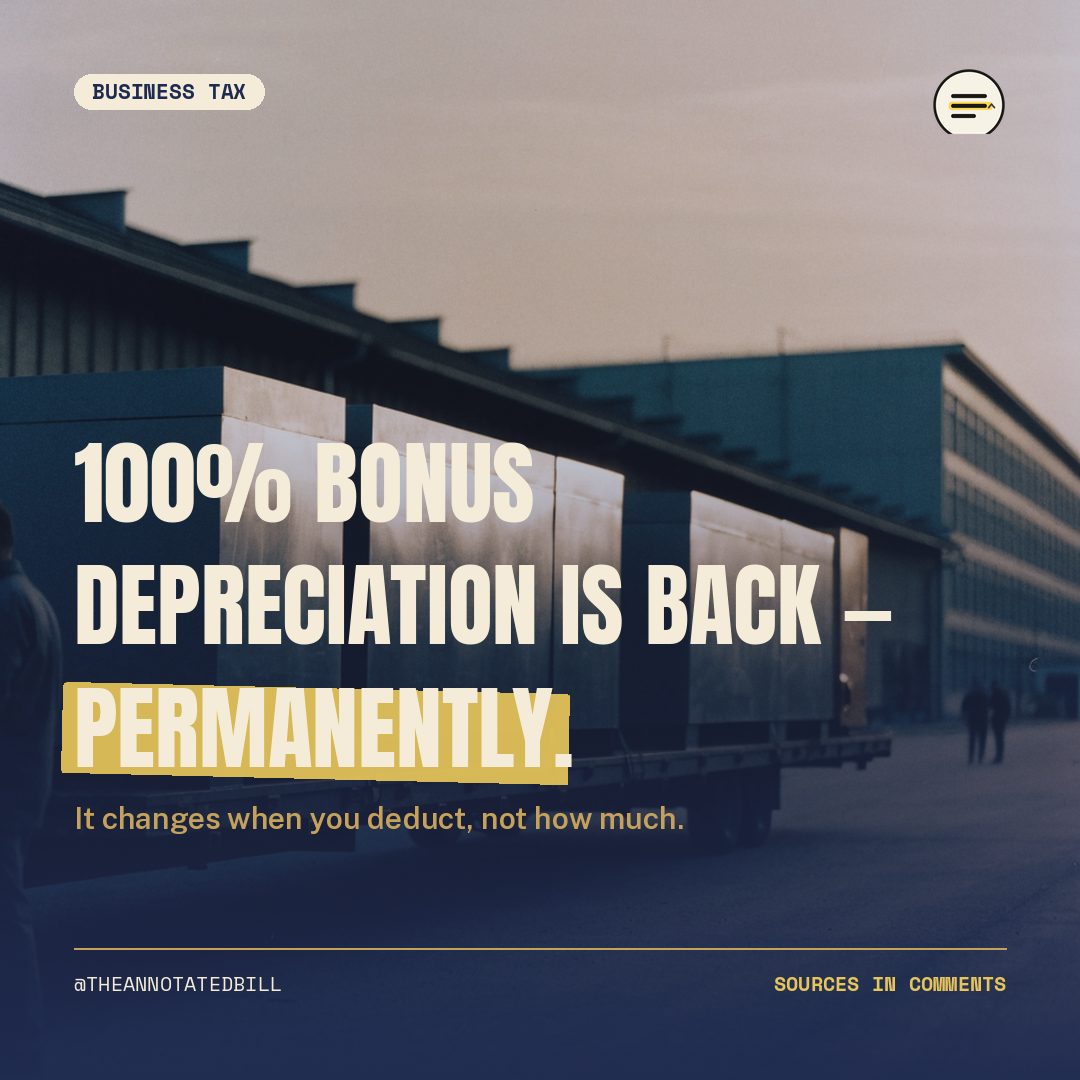
Full expensing, and what it actually does
P.L. 119-21 restores 100% first-year bonus depreciation for qualified property and makes it permanent, with no phase-down scheduled. It also creates a new expensing allowance for qualified production property.
Full expensing changes when a business deducts the cost, not how much it deducts in total CRS R48611.
Margin noteA $1 million machine generates $1 million of deductions either way. Under ordinary depreciation that is spread across the asset’s useful life; under full expensing it all lands in year one. The lifetime deduction is identical. The cash flow is not — and for capital investment decisions, cash flow is the variable that matters.
Twenty-three years of temporary
Bonus depreciation was created by the Job Creation and Worker Assistance Act of 2002 at a rate of 30%, applying to property acquired after September 10, 2001 — explicitly a response to the recession that followed that date.
It rose to 50% under the Jobs and Growth Tax Relief Reconciliation Act of 2003. It reached 100% for the first time under the 2010 Tax Relief Act, for assets acquired between September 2010 and January 2012. The Tax Cuts and Jobs Act set it at 100% for property placed in service from late 2017, then stepped it down: 80% in 2023, 60% in 2024, 40% in 2025, 20% in 2026, and zero after that.

That history is the strongest argument for what this law did. A tax provision designed to encourage long-horizon capital investment, re-legislated every two or three years, produces a predictable distortion: firms accelerate purchases to beat an expiry rather than buying when the economics justify it.
The largest provisions are rarely the loudest
Full expensing is among the biggest-dollar items in P.L. 119-21 and received a fraction of the coverage given to the tips and overtime deductions, which are capped, income-limited and expire after 2028.

The asymmetry is structural. A provision that affects individuals directly, in a way that fits in a headline, generates coverage. A provision that changes the timing of corporate deductions does not — even when it moves far more money, and even when it is permanent while the others are not.
Both cases, in their own words
This site does not referee motives. Here is each side’s strongest version, at the same length and in the same register.
Permanence removes a real distortion
Repeatedly expiring provisions push firms to time purchases around tax deadlines rather than business need. Making the rule permanent removes the cliff and the gaming that comes with it.
Deferral is not forgiveness
The total deduction is unchanged; only its timing moves. Supporters argue the headline revenue cost overstates the long-run effect because deductions taken now are deductions not taken later.
It favours capital-intensive production
Manufacturing, agriculture, construction and transport carry the heaviest equipment costs and benefit most, which is the stated policy goal.
Deferral is worth real money
A deduction today is worth more than the same deduction spread over a decade. Critics argue calling it merely a timing change understates a permanent transfer in present-value terms.
The evidence on new investment is mixed
Studies of past bonus depreciation episodes find effects that are real but smaller than advertised, with a substantial share of the benefit going to purchases that would have happened regardless.
It is permanent while household relief is not
The tips, overtime and senior deductions expire after 2028, and SALT reverts in 2030. Critics point to the asymmetry: the business provisions in this law are disproportionately the permanent ones.
The honest framing was never about the rate
The rate has been 30%, 50%, 100%, 80%, 60% and 40% at various points since 2002. The number that changed in this law is not the percentage. It is the expiry date, which no longer exists.
Businesses
Can now plan capital spending without reference to a tax cliff for the first time since 2002.
The revenue cost
Is front-loaded and partially reverses over time, which is why ten-year scores understate and one-year scores overstate it.
The asymmetry
Is the political fact worth noting: this provision is permanent, and most of the individual relief in the same law is not.
What is settled, for now: 100% first-year expensing, permanent, no phase-down scheduled, plus a new allowance for qualified production property.
Sources
Every claim above traces to one of these.
- P.L. 119-21 — restoration of 100% bonus depreciation, made permanent; new expensing allowance for qualified production property
- CRS R48611, Tax Provisions in P.L. 119-21
- Job Creation and Worker Assistance Act of 2002 — creation of bonus depreciation at 30% for property acquired after September 10, 2001
- Jobs and Growth Tax Relief Reconciliation Act of 2003 — increase to 50%
- Tax Relief, Unemployment Insurance Reauthorization, and Job Creation Act of 2010 — 100% expensing for assets acquired September 2010 to January 2012
- Tax Cuts and Jobs Act phase-down schedule: 80% (2023), 60% (2024), 40% (2025), 20% (2026)
Send it to someone buying equipment
Every figure above is sourced. Pass it on with the sources attached.
The startup stock break just got bigger
Among the most generous provisions in the code, and among the least covered.