The paid leave credit is permanent. In 2021, 12,700 businesses used it.
The paid leave credit is permanent. In 2021, 12,700 businesses used it.
The United States has no federal paid leave mandate. What it has is a tax credit for employers who provide leave voluntarily — created in 2017, expiring at the end of 2025, and now made permanent. Its problem has never been its expiry date.
12,700
Businesses claiming the credit in 2021
$207M
Total claimed that year
2017
Year the credit was created
0
Workers given a right to leave by it
The short version
This breakdown went out as a carousel the same day. Same numbers, fewer words.
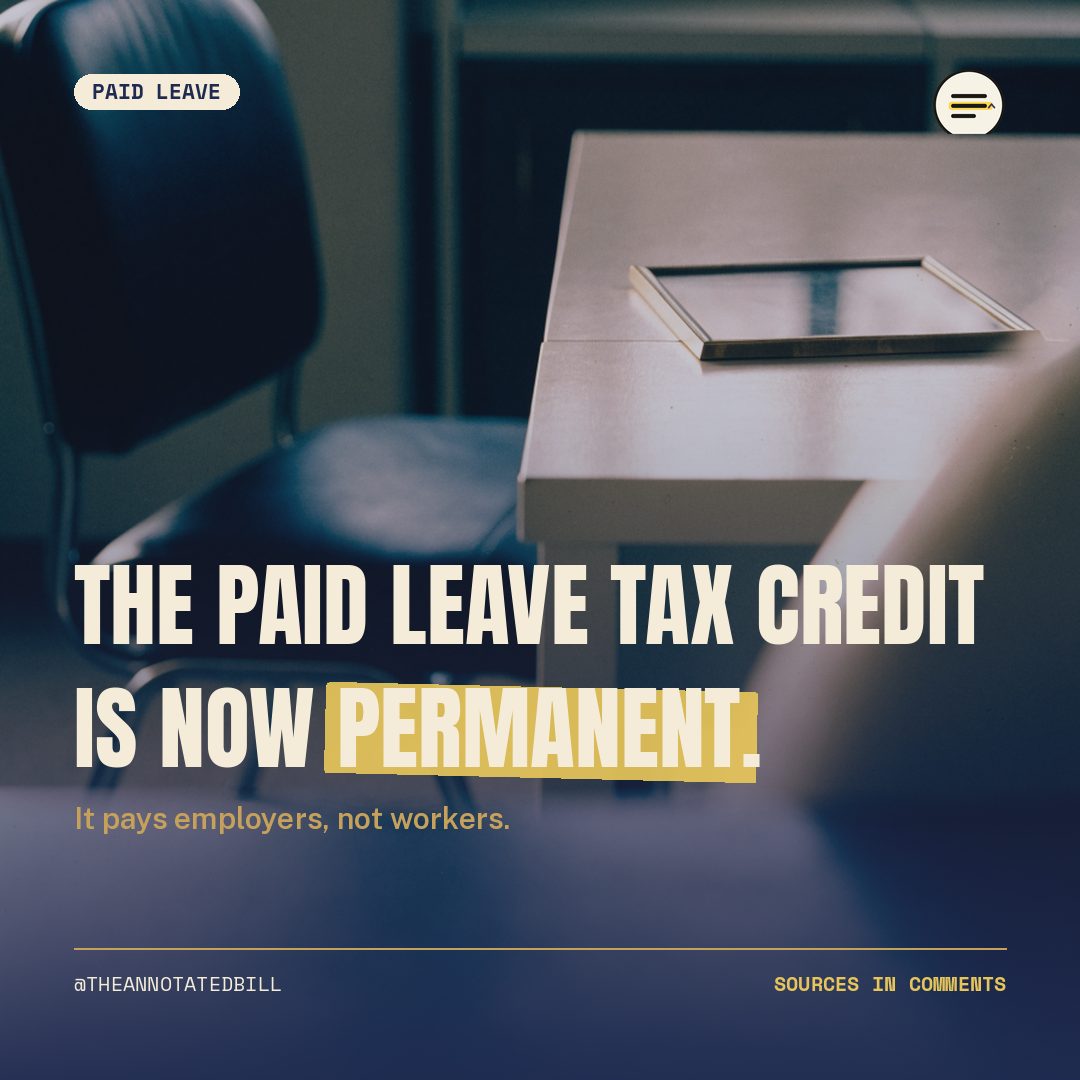
What the credit is, and what it is not
Section 70304 of P.L. 119-21 expands the employer credit for paid family and medical leave under IRC §45S and makes it permanent. It was otherwise scheduled to lapse after 2025.
The credit goes to employers who voluntarily offer paid leave, not to workers taking it IRC §45S.
Margin noteThis is the distinction the name obscures. The provision creates no entitlement to leave, requires no employer to offer any, and sends nothing to a worker. It reduces the cost for a firm that has already decided to provide the benefit.
There is no employer size threshold — firms of any size may qualify, whether or not they are subject to the federal Family and Medical Leave Act.
FMLA guarantees time, not pay
The Family and Medical Leave Act of 1993 gives eligible workers job-protected leave for serious health conditions, new children and family care. That leave is unpaid. FMLA also does not reach employees of small firms or those with insufficient tenure.

The United States remains without a federal paid leave requirement. The §45S credit is the main federal instrument addressing that gap, and it operates by subsidy rather than mandate — a materially different policy with a materially different distribution of effects. Firms large and organised enough to run a structured leave program get help paying for it. Workers at firms without one are unaffected.
The number that defines this provision
In 2021, the most recent year with complete statistics, 12,700 businesses claimed the §45S credit, filing a total of $207 million in claims.

Against the scale of American employment, that is close to nothing. The credit has been described by legislators working on it as among the most underutilised employer benefits in the code, with awareness and uptake well below expectations.
The reasons are structural rather than mysterious. The eligibility conditions are detailed — written policy requirements, minimum leave duration, minimum pay replacement rates — and a firm that already offers leave must document compliance to claim a credit for something it was doing anyway. For most employers, the administrative cost of claiming has exceeded the value of the claim.
Both cases, in their own words
This site does not referee motives. Here is each side’s strongest version, at the same length and in the same register.
Permanence changes employer behaviour
A credit that might vanish in two years cannot be built into a benefits budget. Making it permanent is the precondition for firms treating it as part of the cost of offering leave.
Subsidy beats mandate for small firms
A mandate falls hardest on employers least able to absorb it. A credit lets small firms offer leave they could not otherwise afford, without a compliance obligation attached.
Expansion addresses the uptake problem
The section expands the credit as well as extending it, which is a direct response to the evidence that the original design was too narrow to use.
Twelve thousand firms is a failed program
Critics argue that after seven years, uptake of this scale is evidence the instrument does not work — and that making an unused credit permanent entrenches the appearance of a paid leave policy without the substance.
It mostly pays for leave that already existed
Firms claiming the credit are by definition firms already offering leave. The marginal effect on whether a worker gets paid leave is, critics argue, small.
It leaves the gap where it was
Workers at employers who do not offer leave get nothing from this provision, and they are the group the policy problem is actually about.
The honest framing was never about permanence
Making a credit permanent is a real change for the employers who use it. The question this provision raises is whether a voluntary subsidy claimed by roughly twelve thousand firms is a paid leave policy, or a placeholder where one would otherwise go.
Employers
Get a permanent, expanded credit — and still face the documentation requirements that have kept uptake low.
Workers
Gain no right to leave from this provision. FMLA’s unpaid guarantee remains the federal floor.
Congress
Has now chosen the subsidy approach permanently, which settles the instrument even as the coverage gap stays open.
What is settled, for now: §45S is permanent and expanded, available to employers of any size, claimed by about 12,700 businesses in its most recent fully reported year, and attached to no worker entitlement of any kind.
Sources
Every claim above traces to one of these.
- P.L. 119-21 §70304 — expansion of the IRC §45S employer credit for paid family and medical leave, made permanent
- CRS IF11141, Employer Tax Credit for Paid Family and Medical Leave
- Treasury §45S claims data — 12,700 businesses claiming the credit in 2021, totalling $207 million
- Scheduled expiration of §45S after 2025 absent legislation
- Tax Cuts and Jobs Act of 2017 — creation of §45S
- Family and Medical Leave Act of 1993 — unpaid, job-protected leave; §45S available regardless of FMLA coverage
Send it to someone who thinks this is paid leave
Every figure above is sourced. Pass it on with the sources attached.
100% bonus depreciation is back, permanently
It doesn’t change how much a business deducts. It changes when.