The savings limit for disabled Americans is permanent. The $2,000 trap behind it is not fixed.
The ABLE limit is now permanent. The $2,000 trap behind it is not.
To keep Supplemental Security Income, you generally cannot hold more than $2,000 in assets. That figure has not moved since 1989. ABLE accounts are the workaround Congress built in 2014, and this law makes their higher contribution limit permanent.
$2,000
SSI asset limit for an individual
1989
Last year that limit changed
$100,000
ABLE balance excluded from the SSI limit
~1%
Of eligible SSI recipients who have an account
The short version
This breakdown went out as a carousel the same day. Same numbers, fewer words.
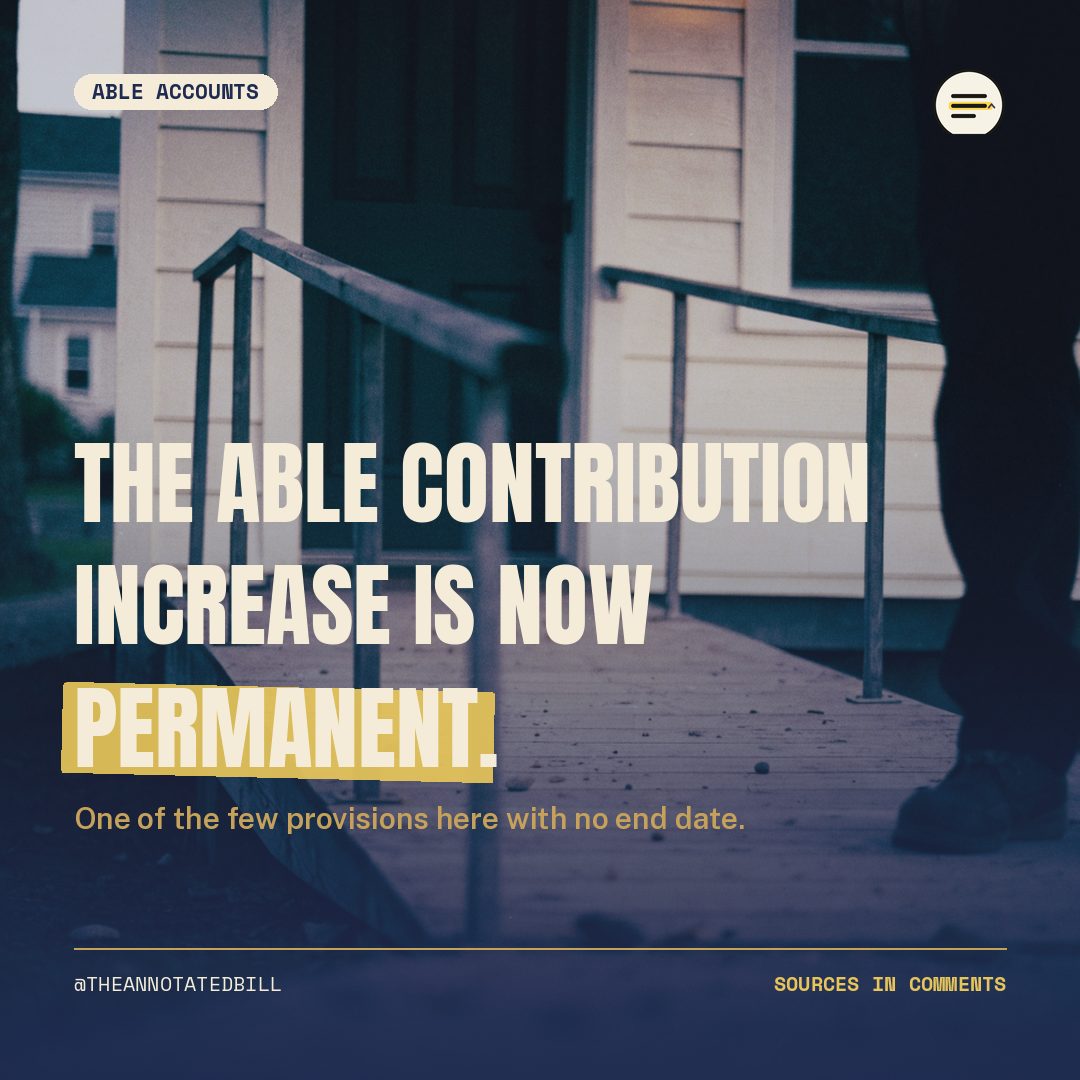
A savings limit set in 1989 and never moved
To qualify for Supplemental Security Income, a recipient generally cannot hold more than $2,000 in countable assets — $3,000 for a couple. Those figures are not indexed to inflation and have been unchanged since 1989.
Saving past $2,000 can cost a recipient both SSI and the Medicaid eligibility attached to it SSI program rules.
Margin noteThis is the trap. The same money that would cover a wheelchair repair, a security deposit, a working car or a few weeks without income can disqualify someone from the benefits and the health coverage they depend on. The rational response is not to save — which is precisely the behaviour the rest of federal policy tries to encourage.
ABLE accounts, and what this law did to them
The Stephen Beck Jr. Achieving a Better Life Experience Act of 2014 created ABLE accounts: tax-advantaged savings accounts for people with disabilities. The first $100,000 held in an ABLE account is excluded from the SSI resource limit, and growth is untaxed when used for qualified disability expenses — housing, transportation, education, health care, employment support.
Section 70115 of P.L. 119-21 makes the increased contribution limit permanent and modifies the formula used to index it. The cap is tied to the federal poverty level for a one-person household in the prior year, or to the beneficiary’s own compensation for the year.

Permanence matters more here than in most provisions. Savings decisions for a person with a lifelong disability are made across decades. A contribution limit that expires on a schedule is difficult to plan against; one that does not is the entire point of the account.
About one percent of the people who could use these have one
The accounts work. The uptake does not. Roughly 1% of eligible SSI recipients hold an ABLE account.

Several things drive that. Eligibility historically depended on disability onset before a specified age, which excluded many people. The accounts are administered through state programs, so availability and quality vary. And the population they serve is, by definition, one with limited surplus income and frequent interaction with benefit rules where a mistake is costly.
Which means a provision that raises and stabilises the contribution ceiling is doing something real for the people already inside the system, and nothing at all for the roughly 99% who are not.
Both cases, in their own words
This site does not referee motives. Here is each side’s strongest version, at the same length and in the same register.
Permanence is the whole benefit
Disability savings run over a lifetime. Removing the expiration date converts a provision people could not safely rely on into one they can build around.
It is targeted and cheap
The population is small and the behaviour encouraged — self-funded independence — reduces reliance on other programs. Supporters argue it is among the highest-return provisions per dollar in the law.
Indexing to the poverty level is coherent
Tying the cap to a measure that moves with the cost of living avoids the exact failure that produced the $2,000 problem.
It treats the symptom
The binding constraint is the $2,000 SSI asset limit, untouched since 1989. Critics argue Congress keeps building workarounds rather than fixing the rule, leaving a structure where saving is legal only through a specific account most people do not have.
The uptake problem is the real problem
At roughly 1% participation, raising the ceiling adjusts a benefit most eligible people are not receiving. Outreach and enrolment, not the cap, are the binding issue.
It requires surplus income to matter
A higher contribution limit is only useful to someone with money left to contribute, which is not the typical circumstance of an SSI recipient.
The honest framing was never about the contribution cap
Two numbers sit at the centre of this. One is a contribution limit Congress just made permanent and indexed. The other is an asset limit that has not changed since 1989, and that this law does not touch.
Congress
Has now twice legislated around the SSI asset limit rather than amending it — in 2014 and again here.
The states
Run the ABLE programs, which is part of why access and awareness vary so widely.
The $2,000
Remains the operative rule for anyone without an ABLE account, which is roughly 99% of the people it applies to.
What is settled, for now: a permanent, indexed ABLE contribution limit, $100,000 of ABLE balance excluded from the SSI resource test — and a $2,000 asset limit that has outlasted every Congress since 1989.
Sources
Every claim above traces to one of these.
- P.L. 119-21 §70115 — ABLE account contribution limits made permanent, indexing formula modified
- Contribution cap tied to the federal poverty level for a one-person household in the prior year, or the beneficiary’s compensation
- Stephen Beck Jr. Achieving a Better Life Experience Act of 2014 — creation of ABLE accounts
- Exclusion of the first $100,000 in an ABLE account from the SSI resource limit
- SSI resource limits of $2,000 (individual) and $3,000 (couple), not indexed and unchanged since 1989
- Qualified disability expenses including housing, transportation, education, health care and employment support
- Participation estimated at approximately 1% of eligible SSI recipients
Send it to someone navigating disability benefits
Every figure above is sourced. Pass it on with the sources attached.
The paid leave tax credit is now permanent
In 2021, 12,700 businesses claimed it.