The remittance tax started at 5%. It landed at 1%, on cash only.
The remittance tax started at 5%. It landed at 1%, on cash only
A new federal excise tax on sending money abroad applies to cash and money orders and not to bank transfers or cards. That single design choice decides almost everything about who pays it.
1%
Final excise tax rate
5%
Rate in the earliest House versions
$15
Transfers at or below this are excepted
0%
Rate on bank wires and card payments
The short version
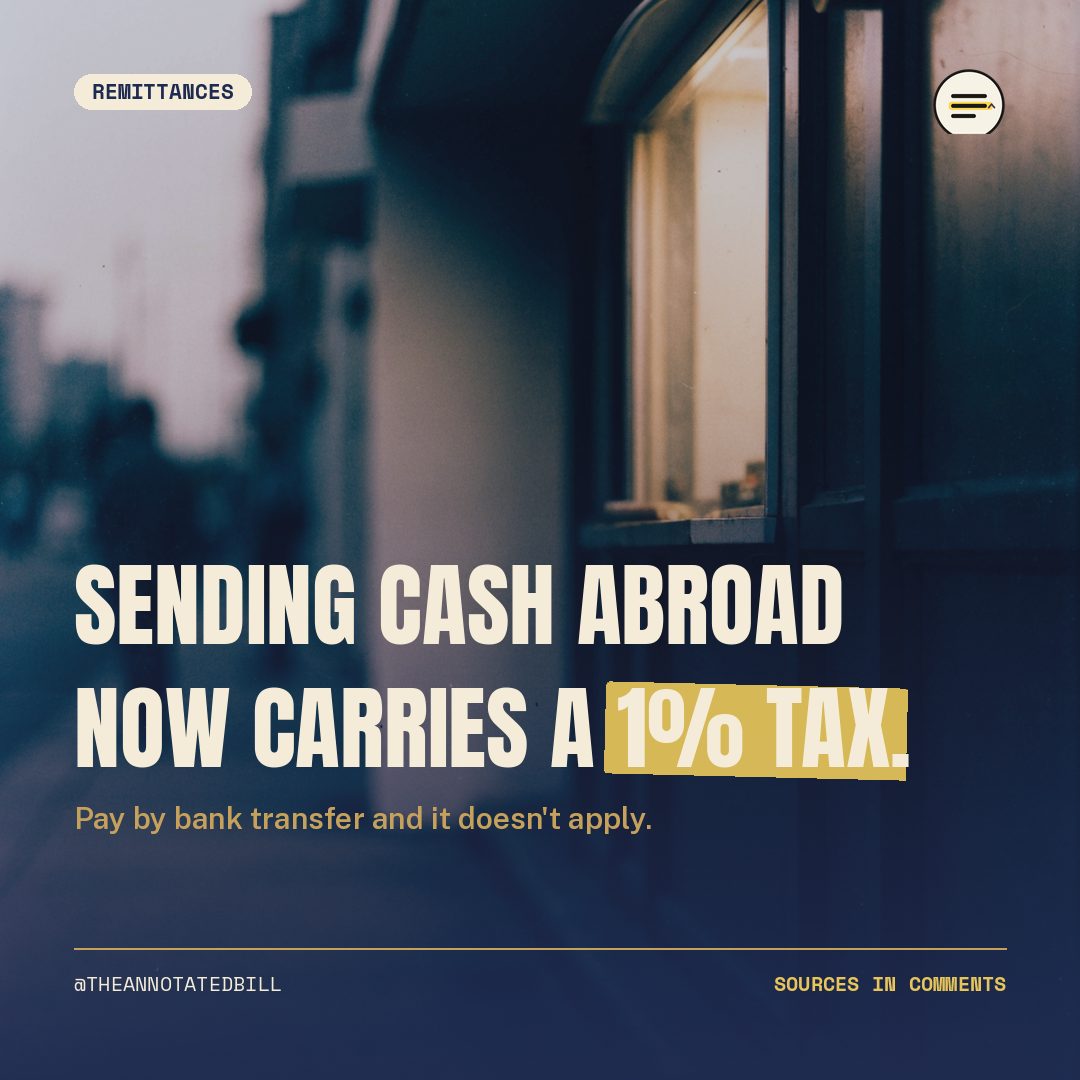
This breakdown went out as a carousel the same day. Same numbers, fewer words.
What is taxed, and what conspicuously is not
Beginning in 2026, P.L. 119-21 imposes a 1% excise tax on certain remittance transfers. The tax does not apply to all transfers abroad. It applies to transfers funded with cash or a money order.
The tax turns on how the transfer was paid for, not on its size, destination, or purpose IRC §4475.
Margin noteWire transfers from a U.S. bank account are outside the tax. So are credit and debit card transactions. Cash handed over at a money services business, an international money order, and a cashier’s check for a cross-border payment are inside it.
There are explicit exceptions for transfers of $15 or less and for remittances funding the purchase of securities and commodities.
The provider owes it either way
U.S. remittance transfer providers collect the tax and remit it to the IRS. If a provider fails to collect it properly, the provider owes it anyway.

That is a deliberate enforcement design, and it works. A business that bears the cost of under-collection will build collection into the price. In practice the tax reaches the sender through the fee, which is where excise taxes on services usually end up.
5%, then 3.5%, then 1%
The provision moved substantially during drafting. Early House versions set the rate at 5%. The House-passed bill reduced it to 3.5%. The Senate version that became law set it at 1% and narrowed the base to cash and money orders.
The compression came after organised objection — from Indian American community groups, immigrant advocacy organisations, and the remittance industry itself, which argued a high rate would push transfers into informal channels that are harder to monitor than the regulated ones.

That is worth noting on its own terms: a 5% tax and a 1% tax on a narrower base are very different policies, and the difference was produced by the ordinary legislative process working in public.
The exemption decides the incidence
A tax on cash-funded transfers is not a neutral tax on sending money abroad. It is a tax on sending money abroad without a bank account.
People who hold bank accounts and send money by wire or card pay nothing. People who are unbanked or underbanked — who are also, on average, sending smaller amounts — pay the full 1%. Whatever one concludes about the policy, the incidence follows mechanically from the funding-method test rather than from any judgment about the senders.
Both cases, in their own words
This site does not referee motives. Here is each side’s strongest version, at the same length and in the same register.
Cash is the hard-to-trace channel
Supporters argue cash-funded transfers are the ones least visible to anti-money-laundering systems, and that attaching a small cost to them is a reasonable way to push volume toward traceable rails.
One percent is modest
At the final rate, a $500 transfer carries $5 of tax — typically less than the provider’s own fee. Supporters note the rate fell by four fifths precisely so the burden would stay small.
The small-transfer exception is real
Excepting transfers of $15 or less keeps the smallest payments out of the system entirely.
It is a tax on not having a bank account
The exemption for wires and cards means the tax falls almost exclusively on unbanked senders. Critics argue that is a regressive outcome produced by the design, not an unintended side effect.
It may push transfers off the record
The industry’s own objection during drafting was that taxing regulated channels encourages informal ones — the opposite of the traceability rationale.
Remittances are already-taxed income
Money being sent home has generally already been through U.S. payroll and income tax. Critics describe the excise as a second charge on the same dollars.
The honest framing was never about the rate
Most of the public argument was about whether 5% was too high. The provision that passed is 1% — and the more consequential decision was not the rate but the base.
The base
Cash and money orders only. That is the clause that determines who pays and who does not.
The providers
Collect it and are liable for it, which means compliance will be high and the cost will show up in fees.
The IRS
Has issued proposed regulations; the definition of a covered transfer is still being settled in guidance.
What is settled, for now: 1% from 2026, cash and money orders only, $15 and under excepted, bank wires and card payments untouched.
Sources
Every claim above traces to one of these.
- P.L. 119-21 — remittance transfer excise tax, effective 2026
- IRS proposed regulations implementing IRC §4475
- Rate of 1% on transfers funded with cash or money orders
- Exceptions for transfers of $15 or less and for remittances funding securities and commodities purchases
- Exemption of wire transfers from U.S. bank accounts and credit and debit card transactions
- Rate history: 5% in early House versions, 3.5% in the House-passed bill, 1% in the enacted Senate version
- Provider collection and liability for uncollected tax
Send it to someone who sends money home
Every figure above is sourced. Pass it on with the sources attached.
The college endowment tax now tops out at 8%
Fewer schools pay it. The ones that do pay considerably more.