The charitable deduction for non-itemizers is back, for the third time
The charitable deduction for non-itemizers is back, for the third time
Most Americans get no tax recognition for giving, because most Americans do not itemize. Congress has now fixed that three times — twice temporarily, during a pandemic. This version has no expiration date written into the headline.
$1,000
Deduction, single filer
$2,000
Deduction, married filing jointly
2026
First tax year it applies
Cash
The only form that qualifies
The short version
This breakdown went out as a carousel the same day. Same numbers, fewer words.
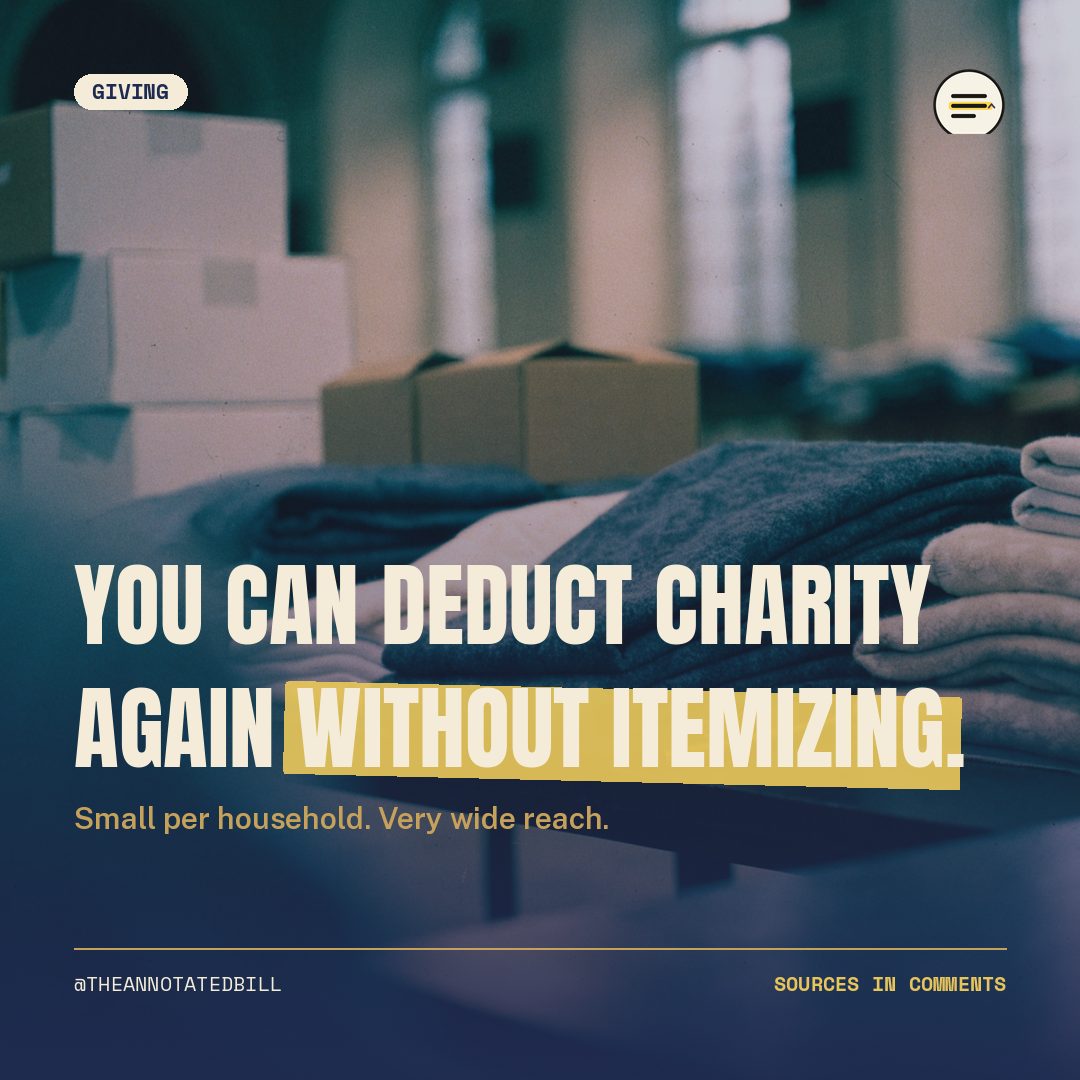
A deduction that sits above the line
Beginning in tax year 2026, taxpayers who do not itemize may deduct charitable contributions of up to $1,000 for a single filer and $2,000 for a married couple filing jointly.
The deduction is available without itemizing, on top of the standard deduction P.L. 119-21.
Margin noteOrdinarily, charitable giving is an itemized deduction — you only benefit if your itemized total exceeds the standard deduction. Since the standard deduction was roughly doubled in 2017, the large majority of filers take it, which means the charitable deduction has had no effect on their taxes at all.
The conditions are tight. The gift has to be cash — currency, check, card or electronic transfer — and it has to go to a public charity. Donated goods do not count. Neither does appreciated stock, and neither do contributions to donor-advised funds.
Congress has tried this twice before, both times briefly
This is the third version of a non-itemizer charitable deduction in six years. The CARES Act created one for 2020, capped at $300. The following year’s relief legislation extended it for 2021 and doubled the ceiling to $600 for joint filers, while leaving single filers at $300. Both lapsed at the end of 2021.

The 2021 expiration mattered to the sector. Nonprofits reported the loss as a particular risk to giving from lower- and middle-income households — precisely the group an above-the-line deduction reaches and an itemized one does not.
Small per household, wide across households
In dollar terms this is one of the smaller provisions in P.L. 119-21. A $1,000 deduction is worth a few hundred dollars at most, and only to someone who actually gives that much.
In reach it is one of the largest. The provisions that dominated coverage of this law — the qualified small business stock exclusion, full expensing, the pass-through deduction — reach specific and relatively narrow populations. This one is available to the majority of filers who take the standard deduction, which is most of the country.

Both cases, in their own words
This site does not referee motives. Here is each side’s strongest version, at the same length and in the same register.
It restores a broken incentive
Doubling the standard deduction in 2017 removed the tax incentive to give for most households as a side effect, not as a deliberate choice. Supporters argue this repairs collateral damage rather than creating a new subsidy.
It reaches donors the sector depends on
Small and mid-sized gifts from ordinary households are the base of most community nonprofits. A deduction only itemizers can use tilts the charitable tax benefit toward high earners.
Cash-only is a real guardrail
Restricting it to cash avoids the valuation disputes that make non-cash charitable deductions an enforcement problem.
The evidence on behaviour is thin
Critics argue most small-dollar giving is motivated by the cause, not the deduction, which would make this a tax cut for giving that was going to happen anyway rather than an incentive for new giving.
The exclusions are arbitrary
A household donating $1,000 of cash qualifies; one donating $1,000 of goods to the same charity does not. The distinction is administrative convenience, not principle.
It adds another thing to substantiate
Every above-the-line deduction creates a new documentation requirement for filers who had none, and a new verification problem for the IRS.
The honest framing was never about the money
This provision is a test of a proposition: that the tax code should recognise giving by people who do not itemize. Congress has now affirmed that proposition three times, and allowed it to lapse twice.
The sector
Has argued for a permanent non-itemizer deduction since the 2017 standard deduction change. This is the closest it has come.
The ceiling
At $1,000 and $2,000 it is three times the CARES version, which is a meaningful escalation in a provision that keeps returning.
The cash rule
Keeps it simple and keeps it narrow. It also excludes the kind of giving — goods, stock — that larger donors use.
What is settled, for now: $1,000 and $2,000, cash only, public charities only, starting in tax year 2026, available to the majority of filers who never itemize.
Sources
Every claim above traces to one of these.
- P.L. 119-21 — charitable contribution deduction for non-itemizers, effective tax year 2026
- Limits of $1,000 (single) and $2,000 (married filing jointly)
- Requirement that contributions be cash to a public charity; exclusion of donated goods and donor-advised funds
- CARES Act (2020) — $300 above-the-line deduction for non-itemizers
- Consolidated Appropriations Act, 2021 — extension for 2021 with a $600 ceiling for joint filers
- Expiration of the CARES-era non-itemizer deduction on December 31, 2021
Send it to someone who gives and doesn’t itemize
Every figure above is sourced. Pass it on with the sources attached.
Sending cash abroad now carries a 1% tax
Pay by bank transfer and it doesn’t apply at all.