“No tax on tips” is a deduction, and 68 occupations long
“No tax on tips” is a deduction, and 68 occupations long
Four words became a campaign promise, then a statute, then a list. The deduction is real, it is capped at $25,000, it phases out, it expires after 2028 — and whether you get it depends on a Treasury list of 68 jobs frozen as of December 31, 2024.
$25,000
Maximum qualified tips deductible
68
Occupations on Treasury’s list
2028
Last tax year before it expires
0%
Reduction in payroll tax on tips
The short version
This breakdown went out as a carousel the same day. Same numbers, fewer words.
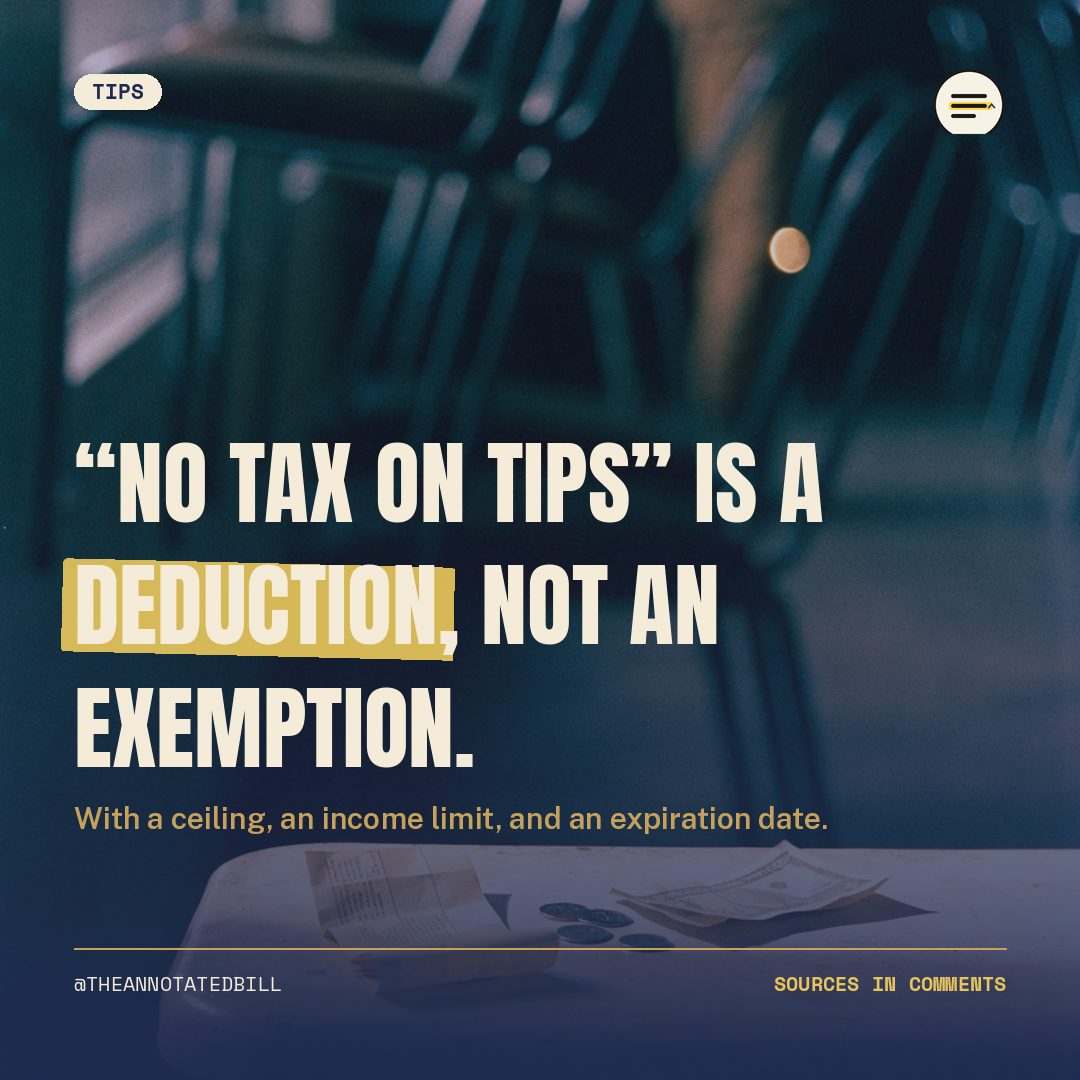
A new section of the tax code, written for four words
Section 70201 of P.L. 119-21 created a new provision of the Internal Revenue Code — §224 — allowing a deduction for qualified tips of up to $25,000, for employees and independent contractors alike, for tax years 2025 through 2028.
The provision reduces taxable income, not the tax owed, and not the wage base IRC §224.
Margin noteThis is the distinction the slogan erases. A deduction lowers the income figure the rate is applied to. An exemption would remove the income from the system. Tips remain reportable, remain wages for payroll purposes, and remain on the W-2.
It is available whether or not you itemize, which matters: most tipped workers take the standard deduction, and a deduction only available to itemizers would have missed nearly all of them.
Four of them, and the fourth is the one nobody mentions
Three limits are straightforward. The deduction caps at $25,000 of qualified tips. It begins to phase out above $150,000 of adjusted gross income, or $300,000 filing jointly. And it expires after tax year 2028.
The fourth limit is structural, and it is the reason the headline overstates the relief: payroll taxes are untouched. Employees who qualify for the deduction continue to pay Social Security and Medicare tax on their tip income in full.

That matters more for this group than for most. A worker whose income is low enough to owe little or no federal income tax gets little or nothing from an income tax deduction — while still paying payroll tax on every dollar of tips. The relief is real, and it is concentrated among tipped workers with enough income to have a meaningful income tax bill in the first place.
68 occupations, frozen as of December 31, 2024
The statute did not define a tipped worker. It instructed the Secretary of the Treasury to publish, within 90 days of enactment, a list of occupations that customarily and regularly received tips on or before December 31, 2024. Treasury released a preliminary list in September 2025; the proposed regulations that followed name 68 occupations.
Eligibility turns on occupations that customarily received tips on or before December 31, 2024 P.L. 119-21 §70201(h).
Margin noteThe date is doing quiet work. It freezes the universe of eligible jobs at a moment before the law existed — which prevents employers from reclassifying work as tipped to capture the benefit, and also means an occupation that becomes customarily tipped in 2027 is outside the deduction no matter how it is paid.
Qualified tips must also be paid in cash or an equivalent: check, credit or debit card, gift card, or electronic and mobile payment. A tip handed over as merchandise is not a qualified tip.

A list is the price of a narrow benefit
Every element that sounds like fine print is solving a real avoidance problem. Without a cap, high earners could reclassify compensation as tips. Without an income phase-out, the benefit would reach people the slogan never described. Without an occupation list anchored to a date before the statute, industries would have strong reason to restructure pay.
That is the trade. A benefit aimed at a specific group of workers requires a definition of that group, and definitions written in tax law become lists, dates and thresholds. The simpler the slogan, the more machinery sits underneath it.
Both cases, in their own words
This site does not referee motives. Here is each side’s strongest version, at the same length and in the same register.
It reaches a real group
Tipped work is unusually volatile — income varies by shift, season and weather — and tipped workers have historically had little political representation in tax policy. A targeted deduction is a defensible way to deliver relief to people whose earnings are hardest to plan around.
The guardrails are serious
The cap, the phase-out and the frozen occupation list are not loopholes; they are anti-abuse design. Supporters argue the provision was drafted to resist exactly the gaming critics warn about.
Four years is a test, not a trick
A 2028 sunset forces Congress to look at the data before extending. That is arguably more responsible than making it permanent on the strength of a campaign slogan.
It misses the workers who need it most
Because it only touches income tax, a tipped worker who already owes little or no income tax sees little or nothing. Critics argue a payroll tax change or an expanded refundable credit would have reached the bottom of the distribution; this does not.
It treats identical work differently
Two people earning the same amount doing comparable service work get different tax treatment because one occupation made the list and the other did not. That is hard to defend on fairness grounds.
It is temporary relief against a permanent expectation
Workers will plan around it. The deduction disappears after 2028, and its removal will be experienced as a tax increase on the lowest-paid group it touched.
The honest framing was never about tips
A four-word promise met a tax code that cannot say anything in four words. What came out is narrower, more conditional, and more administratively complex than the phrase — which is the normal fate of simple promises in tax law.
Treasury
Writes the list, and therefore decides in practice who the statute covers. That is substantial delegated power over who gets a tax cut.
Employers
Report the tips. The deduction’s accuracy depends entirely on the reporting system that already exists.
Congress
Set the 2028 expiry and will have to decide, with four years of data, whether to extend, expand or let it lapse.
What is settled, for now: a $25,000 ceiling, a $150,000 phase-out, a 2028 expiry, 68 listed occupations frozen at December 31, 2024 — and payroll tax on every tipped dollar, exactly as before.
Sources
Every claim above traces to one of these.
- P.L. 119-21 §70201, creating IRC §224 — deduction for qualified tips
- CRS R48611, Tax Provisions in P.L. 119-21
- P.L. 119-21 §70201(h) — requirement that Treasury publish an occupation list within 90 days of the July 4, 2025 enactment
- Treasury preliminary list of tipped occupations, September 2025
- Proposed regulations identifying 68 qualifying occupations, Federal Register, September 22, 2025
- Definition of qualified tips: cash or equivalent, including check, card, gift card and electronic payment
- Phase-out thresholds of $150,000 AGI ($300,000 joint)
- Continued application of Social Security and Medicare payroll taxes to tip income
Send it to someone who works for tips
Every figure above is sourced. Pass it on with the sources attached.
The estate tax exemption is now $15 million a person
It was scheduled to be cut roughly in half. It wasn’t.